The load-carrying structure of a fuselage: the shell of skin, stringers and frames, the floors with their cross beams, struts and longitudinal beams, the pressure bulkheads, walls, doors, windows and intercostals, and the areas where the wing and the tailplane are attached. All parts are given in the fuselage coordinate system; stringers and frames are placed on the surface of the fuselage by positions (stringerFramePositionType). Their cross sections and sheets are structural elements of the vehicle (structuralElementsType), referenced by UID.
Shell
Stringers run along the fuselage and frames around it, each a profile swept along a path on the surface (stringerType, frameType). The skin is the surface itself; skin panels between two frames and two stringers give parts of it a sheet of their own (skinType, skinSegmentType). Ducts and vessels describe their shells with the same types.
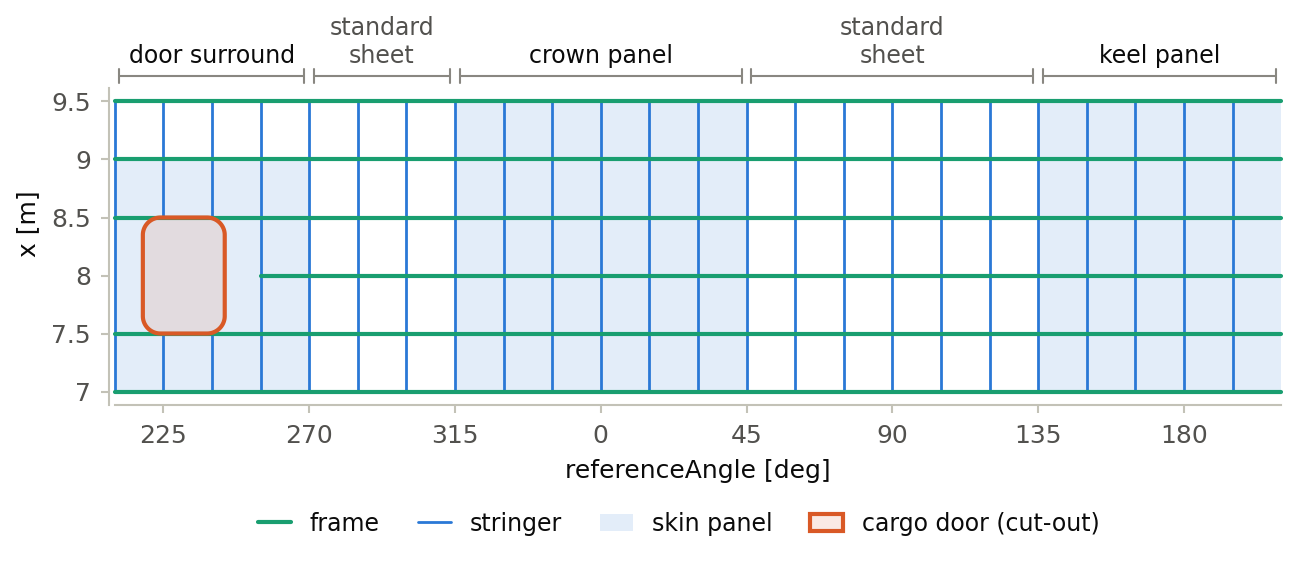
The figure shows the shell of a barrel of the example fuselage around its forward cargo door, developed into the plane: along x from 7 m to 9.5 m, around the fuselage by <referenceAngle>. Six frames stand at a pitch of 0.5 m, and 24 stringers run every 15°. The frame at x = 8 m runs over the top from the stringer above the door to the stringer below it, and the two stringers through the door end at the frames at its edges. Three skin panels cover the top across 0°, the bottom and the surroundings of the door; the rest of the skin is the standard sheet.
Floors
A floor stands on cross beams, which span a frame at the height of the floor (crossBeamAssemblyPositionType), and on struts, which support the cross beams against the frames below (crossBeamStrutAssemblyPositionType). Longitudinal floor beams such as seat rails run along the fuselage over the cross beams (longFloorBeamType), and floor panels cover the space between two of them (floorPanelType). The passenger floor and the cargo floor are described in the same way, the one in <paxCrossBeams> and <paxCrossBeamStruts>, the other in <cargoCrossBeams> and <cargoCrossBeamStruts>; the longitudinal floor beams and the floor panels of both are listed together.
Bulkheads and walls
Pressure bulkheads close the pressurised fuselage at a frame (pressureBulkheadAssemblyPositionType), and walls divide its inside, e.g. around the bay of the main landing gear (wallsType).
Doors, windows and intercostals
The structure of a door is the area of the shell between two frames and two stringers in which the door sits (doorAssemblyPositionType), and intercostals between the frames reinforce it (intercostalPositionType). Windows (windowAssemblyPositionType) and general structural members (generalStructuralMemberType) are listed as well; for new data, the openings of doors and windows are cut-outs of the fuselage (fuselageCutOutType).
Load introduction and connections
The center fuselage area (centerFuselageAreaType) and the tailplane attachment area (tailplaneAttachmentAreaType) describe the structure where the wing and the tailplanes are attached. Interfaces between members (interfaceDefinitionsType), groups of UIDs (uIDGroupDefinitionType) and structural mounts (structuralMountType) serve structural models built from the data.