A frame is a circumferential stiffener of the fuselage shell: the profile of a structural element swept along a path around the fuselage on its surface. A frame with one position (stringerFramePositionType) is a whole ring: its path is the cross section of the surface in the plane x = <positionX>, starting at the position and running in the direction of increasing <referenceAngle>.
Several positions
A frame with several positions runs on the surface from each position to the next, in the direction of increasing <referenceAngle>, and ends at its last position. The order of the positions therefore decides which way the frame runs: from 255° to 210°, it passes 270°, 0°, 90° and 180°; from 210° to 255°, it covers only the 45° between them. Such a frame can be part of a ring, e.g. a frame interrupted by a door, or a whole ring whose profile changes around the circumference; a whole ring repeats its first position at the end, e.g. at 0°, 90°, 180°, 270° and 360°. Positions with different <positionX> give a frame that is not planar.
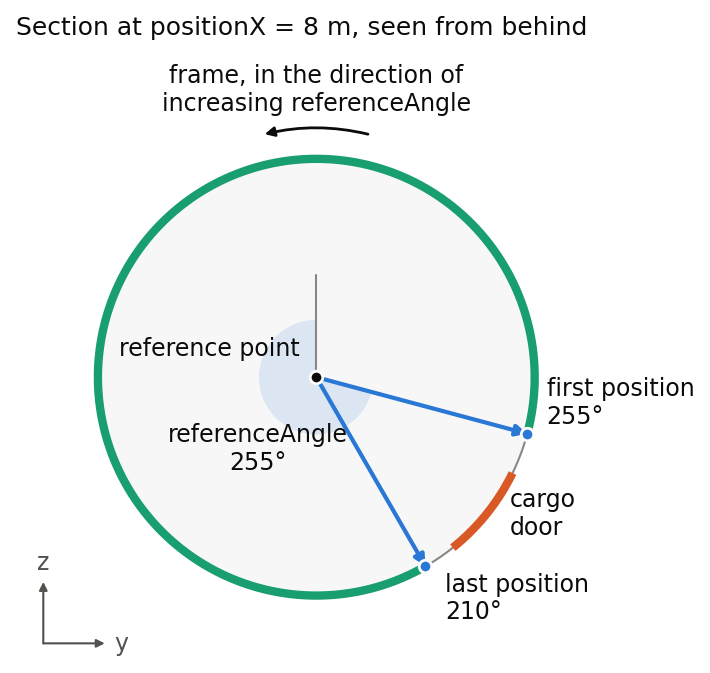
The figure shows the frame of the example below that is interrupted by the forward cargo door, in the section at x = 8 m seen from behind. It starts at the stringer above the door at 255°, runs over the top, the left side and the bottom, and ends at the stringer below the door at 210°.
Example
The first frame of the barrel shown in fuselageStructureType, a whole ring at x = 7 m starting at the top, and the frame interrupted by the cargo door. Both use a Z-profile that is moved inwards by the height of the stringers, so that the frames stand on the stringers (alignmentStringFrameType).
<frames>
    <frame uID="Fuselage_frame1">
        <framePosition uID="Fuselage_frame1_position1">
            <structuralElementUID>ZFrame</structuralElementUID>
            <positionX>7</positionX>
            <referenceY>0</referenceY>
            <referenceZ>0</referenceZ>
            <referenceAngle>0</referenceAngle>
            <alignment uID="Fuselage_frame1_position1_alignment">
                <translationLocZ>0.025</translationLocZ>
            </alignment>
        </framePosition>
    </frame>
    <frame uID="Fuselage_frame3">
        <framePosition uID="Fuselage_frame3_position1">
            <structuralElementUID>ZFrame</structuralElementUID>
            <positionX>8</positionX>
            <referenceY>0</referenceY>
            <referenceZ>0</referenceZ>
            <referenceAngle>255</referenceAngle>
            <alignment uID="Fuselage_frame3_position1_alignment">
                <translationLocZ>0.025</translationLocZ>
            </alignment>
        </framePosition>
        <framePosition uID="Fuselage_frame3_position2">
            <structuralElementUID>ZFrame</structuralElementUID>
            <positionX>8</positionX>
            <referenceY>0</referenceY>
            <referenceZ>0</referenceZ>
            <referenceAngle>210</referenceAngle>
            <alignment uID="Fuselage_frame3_position2_alignment">
                <translationLocZ>0.025</translationLocZ>
            </alignment>
        </framePosition>
    </frame>
    ...
</frames>