A position is a point on the surface of the fuselage through which a stringer or a frame runs (stringerType, frameType). It also names the cross section of the part from this position to the next and says how the part is aligned and joined there. In a duct or a vessel, the surface and the coordinate system are those of that component.
Point on the surface
All values are given in the fuselage coordinate system. A ray starts at the reference point (<positionX>, <referenceY>, <referenceZ>) and runs in the plane x = <positionX>, in the direction of the z-axis rotated about the x-axis by <referenceAngle>: 0° points up, 90° towards −y, i.e. to the left side in flight direction, 180° down and 270° or −90° towards +y. The position is the point where the ray meets the surface. With the reference point on the axis of the fuselage, <referenceAngle> is the angle around the fuselage.
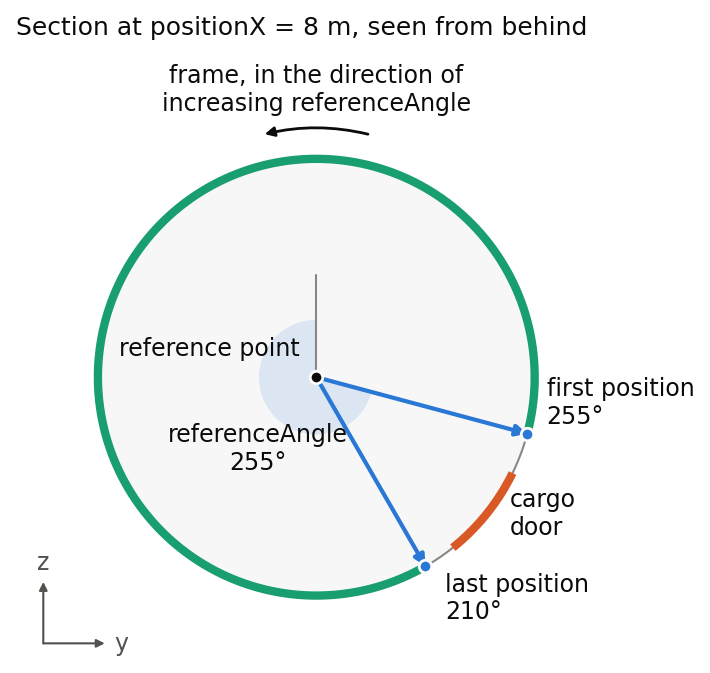
The figure shows the two positions of the frame around the cargo door of the example of frameType: both rays start at the reference point on the axis, at 255° and at 210°.
Instead of <positionX>, <sectionElementUID> can give the plane in which the position lies: the plane of the profile of that section element (fuselageElementType), i.e. the y-z plane of its coordinate system. The reference point is then the point of this plane with y = <referenceY> and z = <referenceZ>, and the ray runs in this plane; its angle is measured from the projection of the z-axis of the fuselage onto the plane, in the same sense as above. For an element whose profile lies in a plane normal to the x-axis, this is the same as giving the x-coordinate of that plane as <positionX>.
Profile
From a position to the next, the part is the profile of the profileBasedStructuralElementType named by <structuralElementUID>, swept along the path; the profile itself is a structuralProfileType. At each point of the path, the profile coordinate system has its x-axis along the path, its z-axis normal to the surface and pointing into the fuselage, and its y-axis completing the right-handed system. The x-axis of the profile lies along this y-axis and the y-axis of the profile along this z-axis, with the origin of the profile on the surface: a profile drawn at y ≥ 0 lies on the inner side of the skin. A stringer runs from its first to its last position and a frame in the direction of increasing <referenceAngle>, so at the top of the fuselage the x-axis of a stringer profile points to the left side and that of a frame profile forward. The <alignment> moves the profile away from this position (alignmentStringFrameType).
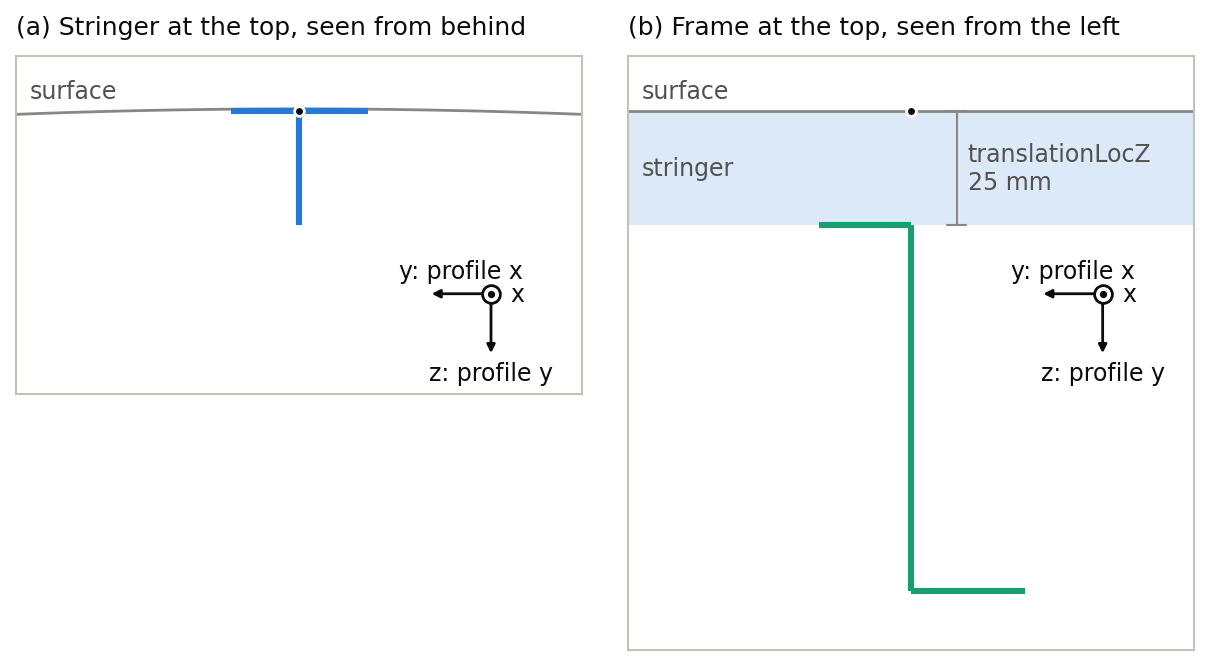
The figure shows both at the top of the fuselage, enlarged: the T-profile of a stringer (a) with its flange on the surface and its web pointing inwards, and the Z-profile of a frame (b), moved inwards by 25 mm onto the stringer.
Between two positions
The <continuity> of a position says whether the part may have a kink there (0, the default) or is continuous in curvature there (2). Between a position and the next, the part has the profile of the first of them; with <interpolation> = 1 at the first, the profile blends linearly along the path into that of the next, e.g. to change the height of a stringer.
Rules
-
The reference point lies inside the fuselage.
Example
The position of the first frame of the example of frameType: a whole ring at x = 7 m, starting at the top, with its Z-profile moved inwards by the 25 mm height of the stringers.
<framePosition uID="Fuselage_frame1_position1">
    <structuralElementUID>ZFrame</structuralElementUID>
    <positionX>7</positionX>
    <referenceY>0</referenceY>
    <referenceZ>0</referenceZ>
    <referenceAngle>0</referenceAngle>
    <alignment uID="Fuselage_frame1_position1_alignment">
        <translationLocZ>0.025</translationLocZ>
    </alignment>
</framePosition>