A cross beam is a transverse beam of a floor, attached to a frame: the profile of a structural element swept along a straight line across the fuselage. The same type describes the cross beams of the passenger floor and of the cargo floor; struts support them (crossBeamStrutAssemblyPositionType), and longitudinal floor beams run over them (longFloorBeamType).
Path
All values are given in the fuselage coordinate system. The cross beam lies in the plane of the frame <frameUID> at the height z = <positionZ>: it runs straight between the two points where the path of the frame has this height, i.e. from the surface on one side of the fuselage to the surface on the other. Its path runs from the end with the larger y to the end with the smaller y, i.e. from the right to the left side in flight direction. A floor with a slope has cross beams with different values of <positionZ>.
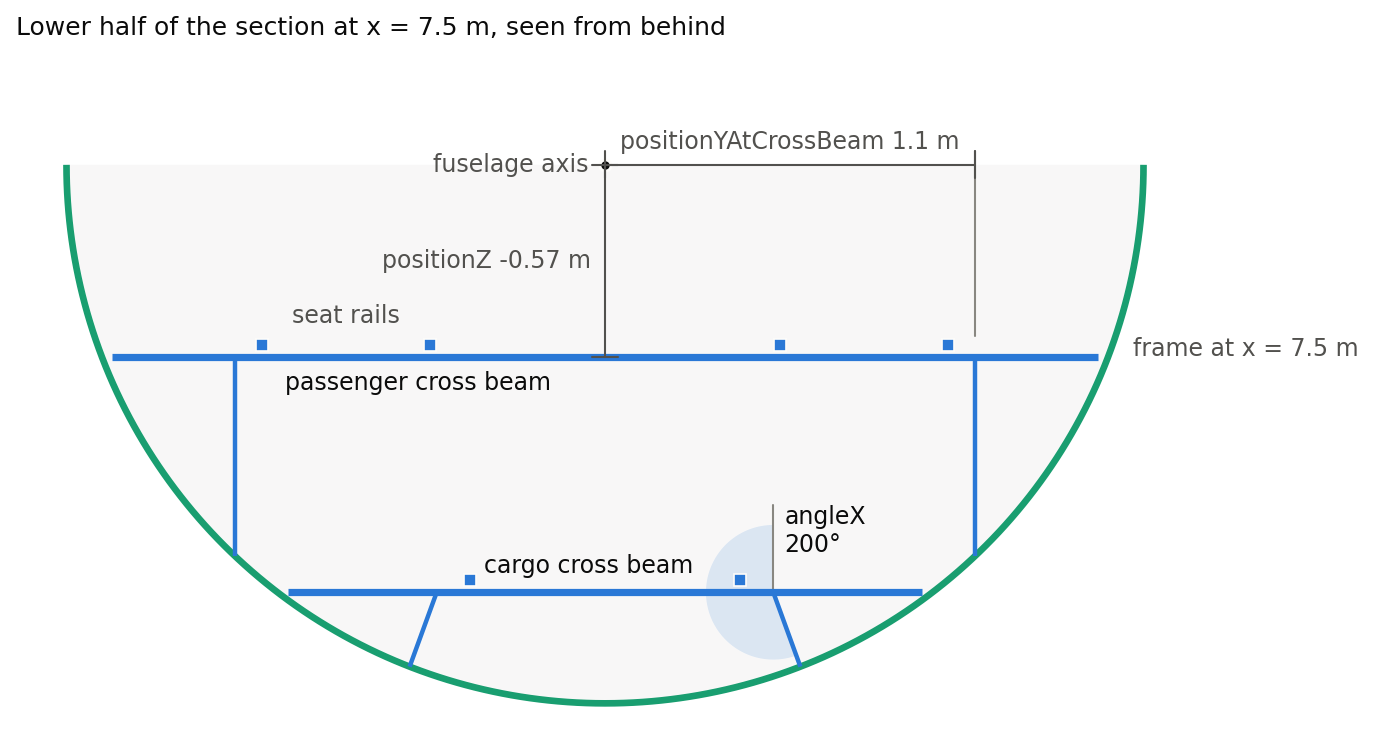
The figure shows the lower half of the section at the second frame of the example: the passenger cross beam at z = −0.57 m, 20 mm below the cabin floor, with four seat rails and two vertical struts, and the cargo cross beam at the sill of the cargo door, on struts inclined outwards.
Profile
The profile of the profileBasedStructuralElementType named by <structuralElementUID> is swept along the path, with its origin on the path. The x-axis of the profile lies along the x-axis of the fuselage, and its y-axis along the direction of the path crossed with the x-axis, i.e. up. A profile drawn at y ≤ 0 therefore hangs below the path, and <positionZ> is the height of its upper edge. The <alignment> shortens the cross beam at its ends and moves or rotates the profile (alignmentCrossBeamType).
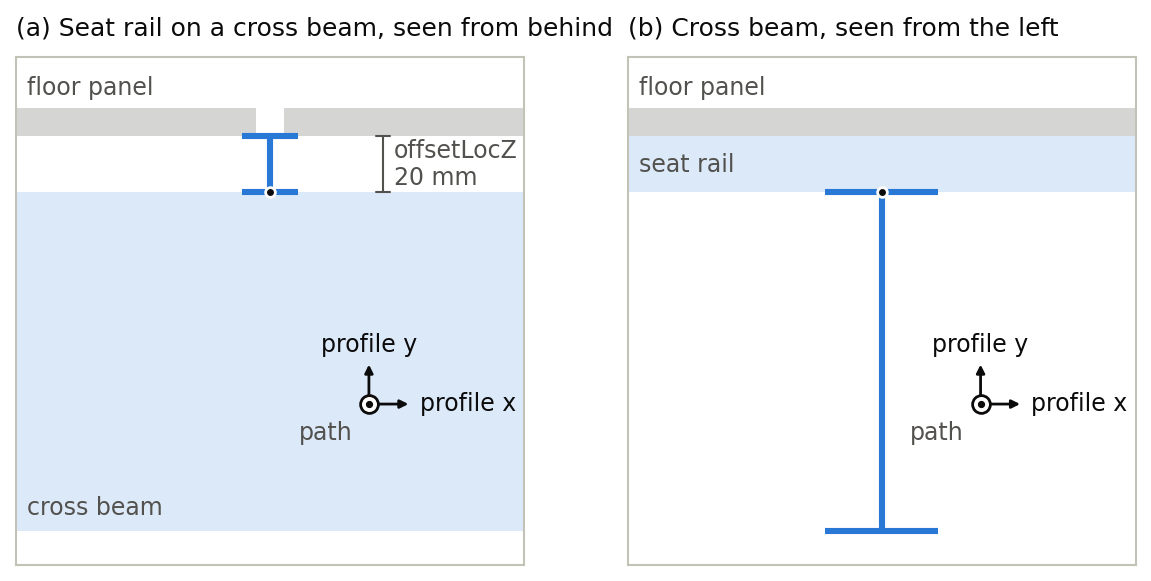
Figure (b) shows the I-profile of the cross beams of the example, 120 mm high below the path, seen from the left, with a seat rail on it; figure (a) shows the seat rail on the cross beam, seen from behind (longFloorBeamPositionType).
Rules
-
The frame reaches the height
<positionZ>on both sides of the fuselage; a frame that is interrupted there, e.g. by a door, carries no cross beam at this height.
Example
The first passenger cross beam of the example, on the frame at x = 7 m, shortened by 30 mm at both ends:
<paxCrossBeams>
    <paxCrossBeam uID="Fuselage_paxCrossBeam1">
        <structuralElementUID>CrossBeam</structuralElementUID>
        <frameUID>Fuselage_frame1</frameUID>
        <positionZ>-0.57</positionZ>
        <alignment uID="Fuselage_paxCrossBeam1_alignment">
            <offset1LocX>0.03</offset1LocX>
            <offset2LocX>0.03</offset2LocX>
        </alignment>
    </paxCrossBeam>
    ...
</paxCrossBeams>