wingStringerType

complexType · extension complexBaseType · sequence

Stringers of a shell or of a cell

All stringers of a shell or of a cell have the same cross section, that of the structural element referenced in stringerStructureUID. They are given in one of two ways:

angle turns the stringers in the surface. It is measured from the straight line through the leading edge points of the first and the last element of the component segment, about the normal of that surface. angleReference replaces that direction by the leading edge, the trailing edge, the y axis of the wing (globalY) or a spar of the structure.
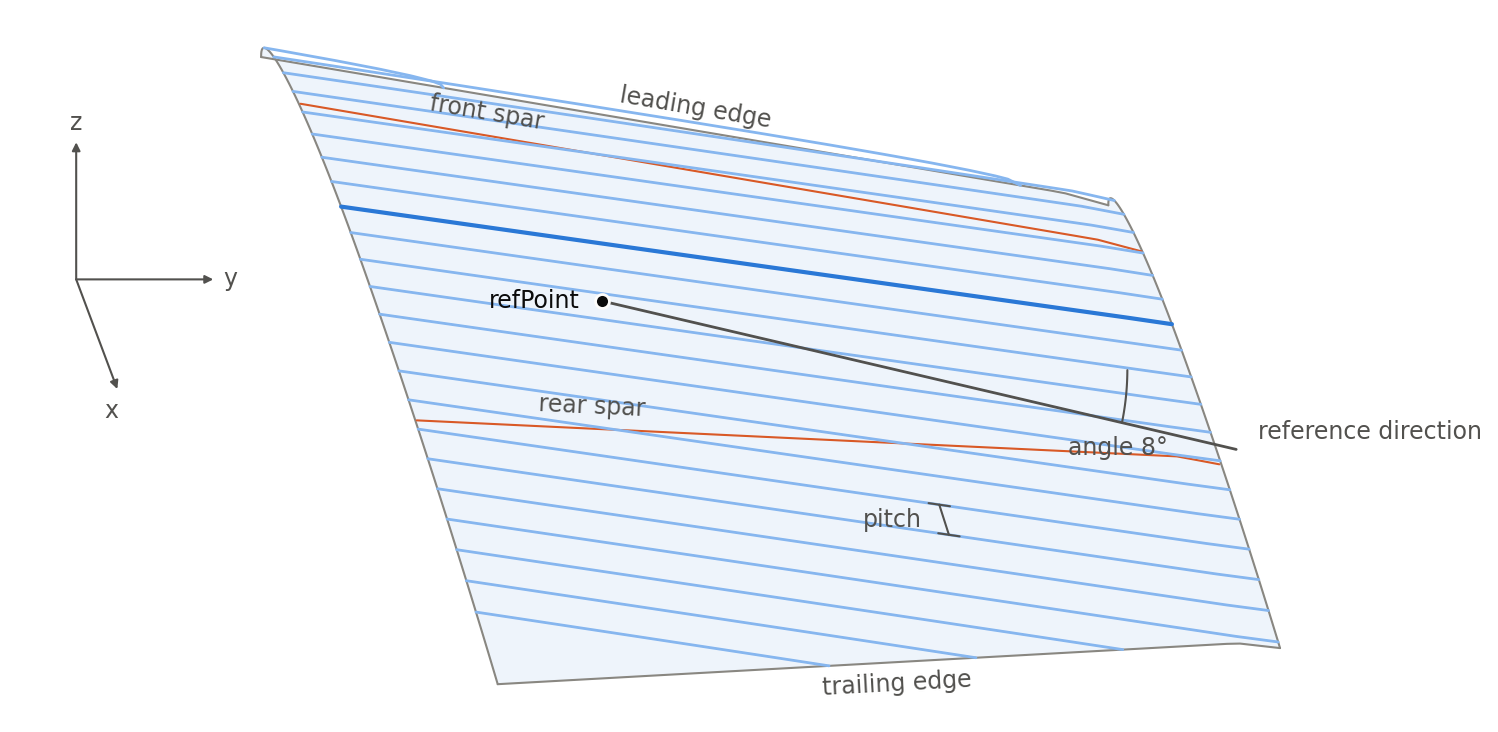
Oblique view of a part of the upper skin of a wing between its leading and its trailing edge, with the traces of the front and the rear spar on it. One stringer, drawn strong, runs through the reference point; the others follow at the pitch from it, which is marked between two of them. All of them are turned by the stringer angle of 8 degrees from the reference direction, the line through the leading edge points of the first and the last element of the component segment

The figure shows a part of the upper skin of the example with its stringers: one of them runs through the reference point, the others at the pitch from it, all turned by the angle from the reference direction.

Attributes

NameTypeConstraintsUseDefaultDescription
@externalDataDirectoryxsd:stringoptionalDirectory of the external data file
@externalDataNodePathxsd:stringoptionalPath of the node inside the external data file
@externalFileNamexsd:stringoptionalName of the external data file

Child elements

NameTypeConstraintsOccurrenceHow often the element may appear at this place. The schema writes it as minOccurs and maxOccurs on the declaration.DefaultDescription
sequenceThe children below must appear in exactly this order. Each may repeat as often as its own occurrence allows.
stringerStructureUIDstringUIDBaseType[1..1] requiredUID of the structural element that gives the cross section of every stringer
choiceExactly one of the alternatives below may appear, unless the occurrence next to this line says otherwise.
sequenceThe children below must appear in exactly this order. Each may repeat as often as its own occurrence allows.
pitchdoubleBaseType[1..1] requiredDistance between two stringers, measured perpendicular to them [m]
refPointetaXsiRelHeightPointType[1..1] requiredPoint through which one of the stringers runs
angledoubleBaseType[1..1] requiredAngle of the stringers in the surface, measured from the reference direction about the normal of the surface [deg]
angleReferencestringBaseType[0..1] optionalDirection the angle is measured from, in place of the reference direction: the UID of a spar, leadingEdge, trailingEdge or globalY
sequenceThe children below must appear in exactly this order. Each may repeat as often as its own occurrence allows.
numberOfStringersintegerBaseType[0..1] optionalNumber of stringers spread between the four borders
angledoubleBaseType[0..1] optionalAngle of the stringers in the surface, measured from the reference direction about the normal of the surface [deg]
angleReferencestringBaseType[0..1] optionalDirection the angle is measured from, in place of the reference direction: the UID of a spar, leadingEdge, trailingEdge or globalY
innerBorderXsiLExsiIsoLineType[0..1] optionalChordwise position of the foremost stringer at its inner end
outerBorderXsiLExsiIsoLineType[0..1] optionalChordwise position of the foremost stringer at its outer end
innerBorderXsiTExsiIsoLineType[0..1] optionalChordwise position of the rearmost stringer at its inner end
outerBorderXsiTExsiIsoLineType[0..1] optionalChordwise position of the rearmost stringer at its outer end

Used by

In a dataset · 50 paths

In the schema · 4 declarations

TypeName
structuralWallElementTypelateralReinforcements
structuralWallElementTypelongitudinalReinforcements
wingCellTypestringer
wingShellTypestringer