The spars of a component segment are defined in two steps. First the spar positions (sparPositions) are given as points of the chord surface of the component segment, the surface spanned by the chord lines of its elements (see componentSegmentType). Then each spar (sparSegments) is built from two or more of these positions and carries its own cross section.
A spar is the surface through its positions, bounded by the surface of the wing. Between two consecutive positions it is a plane surface: it runs straight from one position to the other, not along the lines of constant ξ of the component segment. Its orientation about that line follows from the rotation of the cross section (sparCrossSectionType). On a swept or tapered wing the relative chordwise position therefore drifts between two positions, and the more so the more the chord changes: a spar that is to keep its chordwise position needs a position at each element at which the planform bends.
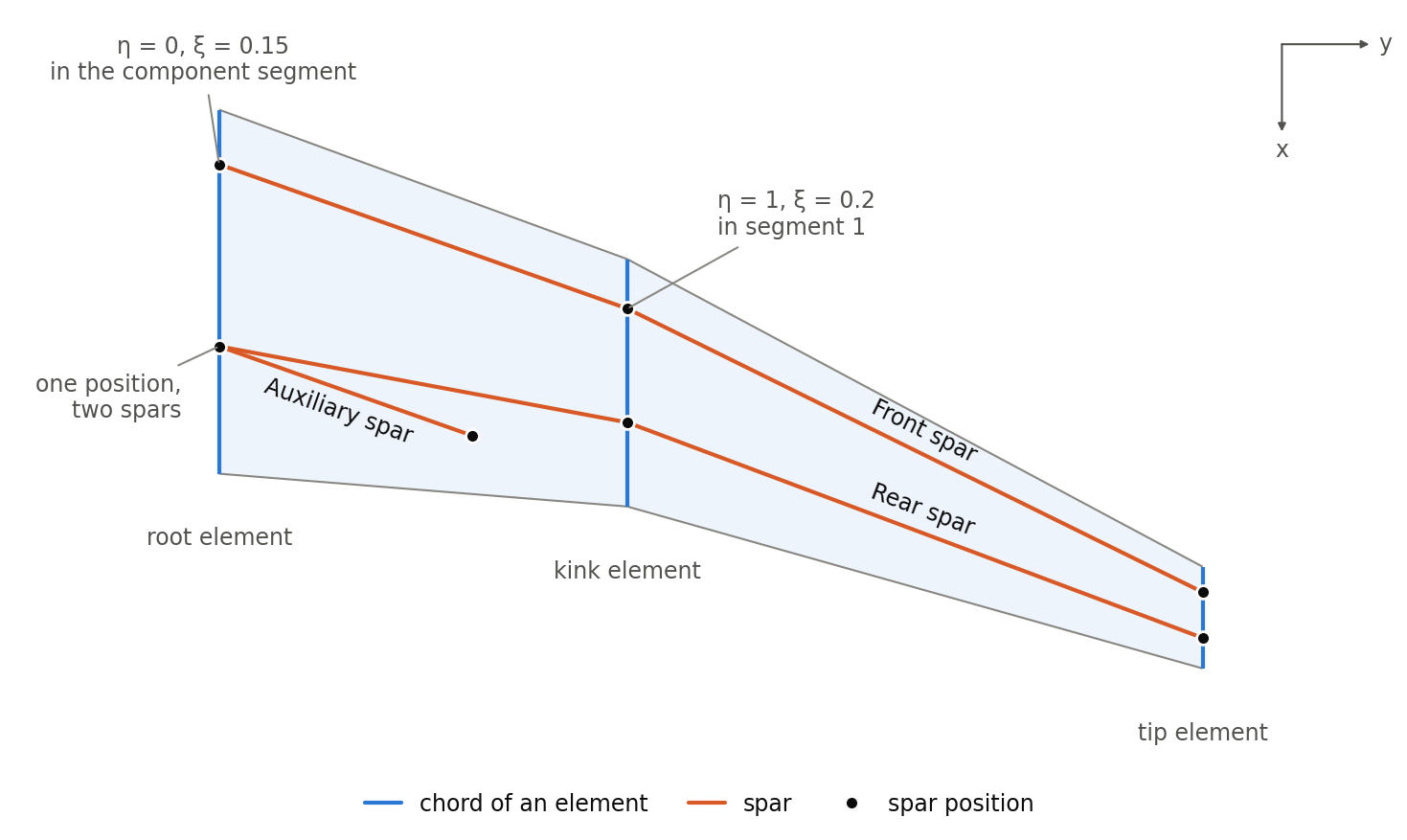
The figure shows three spars of a wing in the top view: a front and a rear spar that both bend at the kink of the wing and keep their chordwise position, and a short auxiliary spar in the inner wing that starts at the same spar position as the rear spar.
Rules
-
The order of the spar positions is the order of the points along the spar, either from root to tip or from tip to root. A spar must not run outward and back inward again.
-
A spar bends at each of its positions. Where it bends is independent of the elements of the wing; a spar may run straight past an element and bend where no element is.
-
One spar position may be used by several spars, e.g. where two spars meet or where an auxiliary spar branches off another one. Spars may also cross each other.
-
A spar position with η = 0 or η = 1 in the coordinates of the component segment lies on its inner or its outer section element, and the spar ends flush with that element.
Position along a spar
Some elements give a position along a spar, e.g. a spar position on another spar (curvePointType) or the borders of a spar cell (sparCellType). They use the mid line of the spar, the line of the spar on the chord surface: it runs straight within each segment of the wing and bends where it crosses an element. η is the relative arc length along this line, 0 at the first and 1 at the last position of the spar.
Example
The front spar of the figure, with the three positions it runs through and its cross section. Its middle position is given in the coordinates of segment 1, so that it lies exactly on the kink element of the wing; the other two are given in the coordinates of the component segment:
<spars>
    <sparPositions>
        <sparPosition uID="Wing_frontSpar_root">
            <sparPositionEtaXsi>
                <eta>0</eta>
                <xsi>0.15</xsi>
                <referenceUID>Wing_componentSegment</referenceUID>
            </sparPositionEtaXsi>
        </sparPosition>
        <sparPosition uID="Wing_frontSpar_kink">
            <sparPositionEtaXsi>
                <eta>1</eta>
                <xsi>0.2</xsi>
                <referenceUID>Wing_segment1</referenceUID>
            </sparPositionEtaXsi>
        </sparPosition>
        <sparPosition uID="Wing_frontSpar_tip">
            <sparPositionEtaXsi>
                <eta>1</eta>
                <xsi>0.25</xsi>
                <referenceUID>Wing_componentSegment</referenceUID>
            </sparPositionEtaXsi>
        </sparPosition>
    </sparPositions>
    <sparSegments>
        <sparSegment uID="Wing_frontSpar">
            <name>Front spar</name>
            <sparPositionUIDs>
                <sparPositionUID>Wing_frontSpar_root</sparPositionUID>
                <sparPositionUID>Wing_frontSpar_kink</sparPositionUID>
                <sparPositionUID>Wing_frontSpar_tip</sparPositionUID>
            </sparPositionUIDs>
            <sparCrossSection>
                <upperCap uID="Wing_frontSpar_upperCap">
                    <area>0.0024</area>
                    <material>
                        <materialUID>Aluminium2024</materialUID>
                        <thickness>0.006</thickness>
                    </material>
                </upperCap>
                <lowerCap uID="Wing_frontSpar_lowerCap">
                    <area>0.0024</area>
                    <material>
                        <materialUID>Aluminium2024</materialUID>
                        <thickness>0.006</thickness>
                    </material>
                </lowerCap>
                <web1>
                    <material>
                        <materialUID>Aluminium2024</materialUID>
                        <thickness>0.004</thickness>
                    </material>
                    <relPos>0.5</relPos>
                </web1>
                <rotation>90</rotation>
            </sparCrossSection>
        </sparSegment>
    </sparSegments>
</spars>