longFloorBeamPositionType

complexType · extension complexBaseType · all

Position of a longitudinal floor beam

A position is the point of a cross beam through which a longitudinal floor beam runs (longFloorBeamType). It also names the cross section of the beam from this position to the next and says how the beam is aligned and joined there.

Point

The position is the point of the path of the cross beam <crossBeamUID> with y = <positionY> in the fuselage coordinate system (crossBeamAssemblyPositionType).

Profile

From a position to the next, the beam is the profile of the profileBasedStructuralElementType named by <structuralElementUID>, swept along the path, with its origin on the path. The y-axis of the profile points up, normal to the path in the vertical plane through it, and its x-axis is this y-axis crossed with the direction of the path: for a beam running aft, it points towards +y. A profile drawn at y ≥ 0 therefore stands on the cross beams, whatever the order of the positions. The <alignment> moves the profile away from this position (alignmentStructMemberType).
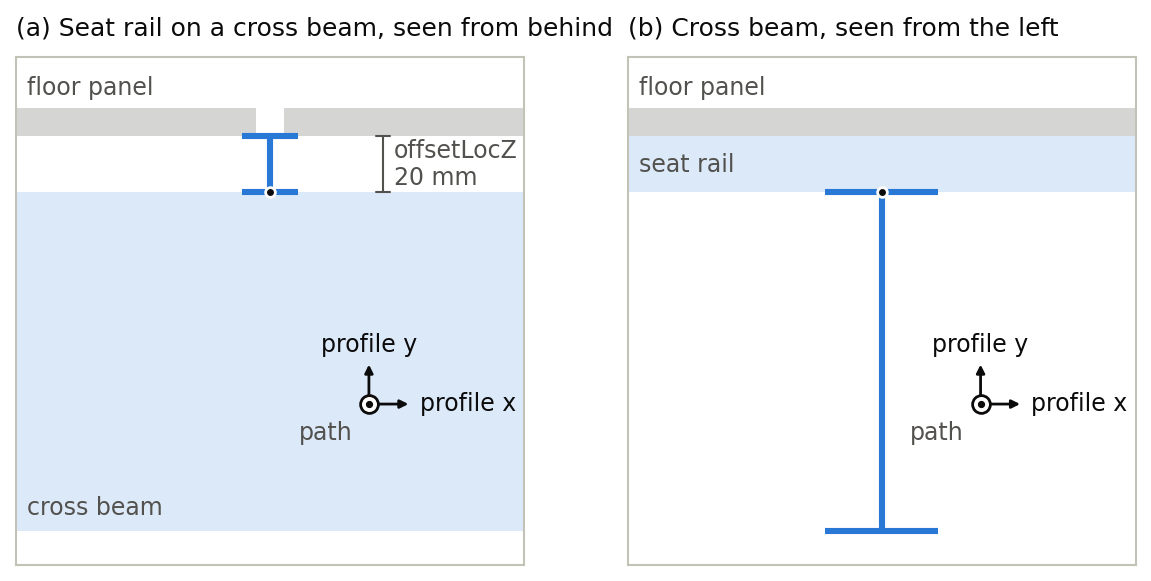
Two details of a floor at the same scale in millimetres: (a) seen from behind, the I-profile of a seat rail, 20 mm high, standing on the upper edge of a cross beam, with the axes of the profile (profile x to the right, along +y; profile y up) and the path pointing out of the drawing, and two floor panels on top of the rail, 20 mm above the path (offsetLocZ), with a gap at the axis of the rail; (b) seen from the left, the I-profile of the cross beam, 120 mm high below its path, with profile x along +x and profile y up, the seat rail and the floor panel on top

Figure (a) shows a seat rail of the example on a cross beam, seen from behind: its I-profile, 20 mm high, stands on the path, and the floor panels lie on top of it; figure (b) shows the cross beam under it, seen from the left.

Between two positions

<continuity> and <interpolation> have the same meaning as at a position of a stringer (stringerFramePositionType).

Example

The first position of the inner right seat rail of the example:

<longFloorBeamPosition uID="Fuselage_paxRailR1_position1">
    <structuralElementUID>SeatRail</structuralElementUID>
    <crossBeamUID>Fuselage_paxCrossBeam1</crossBeamUID>
    <positionY>0.52</positionY>
</longFloorBeamPosition>
Position of a seat rail on a cross beam

Attributes

NameTypeConstraintsUseDefaultDescription
@externalDataDirectoryxsd:stringoptionalDirectory of the external file the element was read from, as URI
@externalDataNodePathxsd:stringoptionalPath of the parent element in the merged dataset, at which the element was inserted from an external file
@externalFileNamexsd:stringoptionalName of the external file the element was read from
@uIDxsd:IDrequiredUID

Child elements

NameTypeConstraintsOccurrenceHow often the element may appear at this place. The schema writes it as minOccurs and maxOccurs on the declaration.DefaultDescription
allThe children below may appear in any order. Each may appear at most once.
structuralElementUIDstringUIDBaseType[1..1] requiredUID of the profileBasedStructuralElement whose profile the beam has from this position to the next
crossBeamUIDstringUIDBaseType[1..1] requiredUID of the cross beam on which the position lies
positionYdoubleBaseType[1..1] requiredY-coordinate of the position on the cross beam, in the fuselage coordinate system [m]
alignmentalignmentStructMemberType[0..1] optionalOffset and rotation of the profile against the path
continuityintegerBaseType2 values[0..1] optional0Continuity of the beam at this position: 0 allows a kink (default), 2 continuous in curvature
interpolationintegerBaseType2 values[0..1] optional0Profile between this position and the next: 0 the profile of this position (default), 1 blending linearly into the profile of the next position

Used by

In a dataset · 2 paths

In the schema · 1 declaration

TypeName
longFloorBeamTypelongFloorBeamPosition