A control surface needs room in the wing: the flap bay of a trailing edge device, the recess behind a leading edge device. The cut-out describes that room. It is removed from the wing, from its outer shape as well as from its structure.
Without a <wingCutOut> the removed part is the control surface itself, so that the control surface fills the opening exactly. A <wingCutOut> describes a larger opening, which leaves the gap the control surface needs to move. It therefore has to contain the control surface: on the upper and on the lower surface of the wing its cut lies ahead of a trailing edge device and behind a leading edge device.
Shape of the cut-out
The cut-out is built like the outer shape of a control surface, from a cut at its inner and at its outer border and the ruled surface through the two cuts.
-
<innerBorder>and<outerBorder>give the spanwise extent (controlSurfaceSkinCutOutBorderType). Without them the cut-out ends at the borders of the control surface. -
<upperSkin>and<lowerSkin>give the chordwise position at which the cut meets the upper and the lower surface of the wing (controlSurfaceSkinCutOutType). -
Between these two points the cut is a straight line.
<cutOutProfileControlPoint>bends it through a point between the two surfaces (cutOutControlPointsType), e.g. so that the wing keeps a nose behind a leading edge device. -
Everything behind the cut is removed for a trailing edge device, everything ahead of it for a leading edge device.
A spoiler lies in the upper surface of the wing, so a cut through the lower surface has no meaning for it. <wingCutOut> is not intended for spoilers.
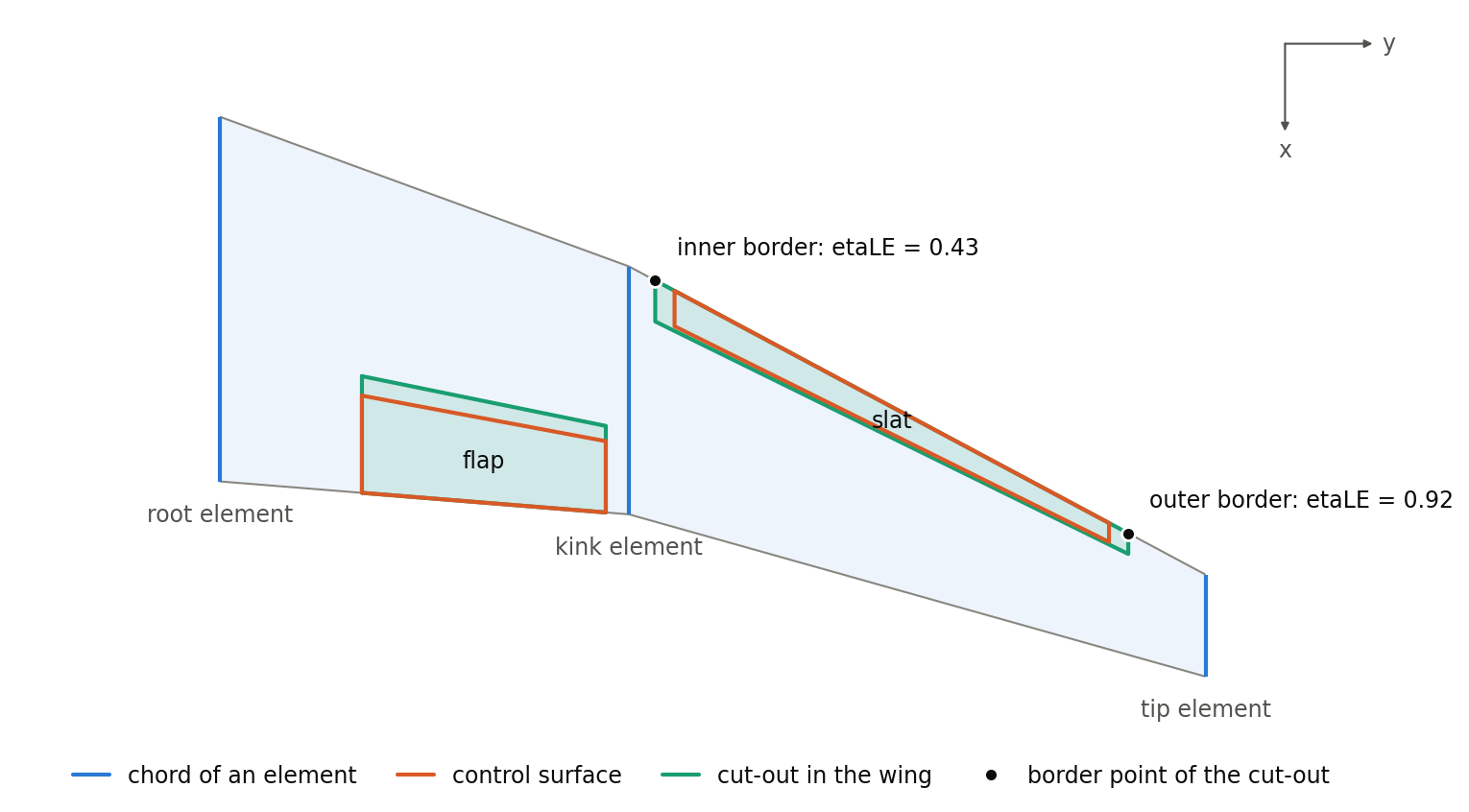
The figure shows the flap and the slat of the example in controlSurfacesType with their cut-outs in the top view. The cut-out of the flap reaches further forward than the flap and ends at its borders; the cut-out of the slat reaches further aft than the slat and has borders of its own.
Example
The cut-out of the slat, with a control point and its own borders; the outer border is defined like the inner one:
<wingCutOut>
    <upperSkin>
        <xsiInnerBorder>0.17</xsiInnerBorder>
        <xsiOuterBorder>0.17</xsiOuterBorder>
    </upperSkin>
    <lowerSkin>
        <xsiInnerBorder>0.14</xsiInnerBorder>
        <xsiOuterBorder>0.14</xsiOuterBorder>
    </lowerSkin>
    <cutOutProfileControlPoint>
        <innerBorder>
            <relHeight>0.45</relHeight>
            <xsi>0.06</xsi>
        </innerBorder>
        <outerBorder>
            <relHeight>0.45</relHeight>
            <xsi>0.06</xsi>
        </outerBorder>
    </cutOutProfileControlPoint>
    <innerBorder>
        <etaLE>
            <eta>0.43</eta>
            <referenceUID>Wing_componentSegment</referenceUID>
        </etaLE>
        <etaTE>
            <eta>0.43</eta>
            <referenceUID>Wing_componentSegment</referenceUID>
        </etaTE>
    </innerBorder>
    <outerBorder>
        ...
    </outerBorder>
</wingCutOut>