An element places an airfoil (airfoilUID) in the section coordinate system. The transformation of the element defines the element coordinate system within the section, and the airfoil, usually defined with a chord length of 1 in the x-z plane, lies in this coordinate system. A scaling in x and z gives the chord length and the thickness; for example, a scaling of 3.4 in x and z turns an airfoil with chord length 1 into one with chord length 3.4. A rotation and a translation move the element coordinate system within the section, e.g. to offset or incline the airfoil against the section.
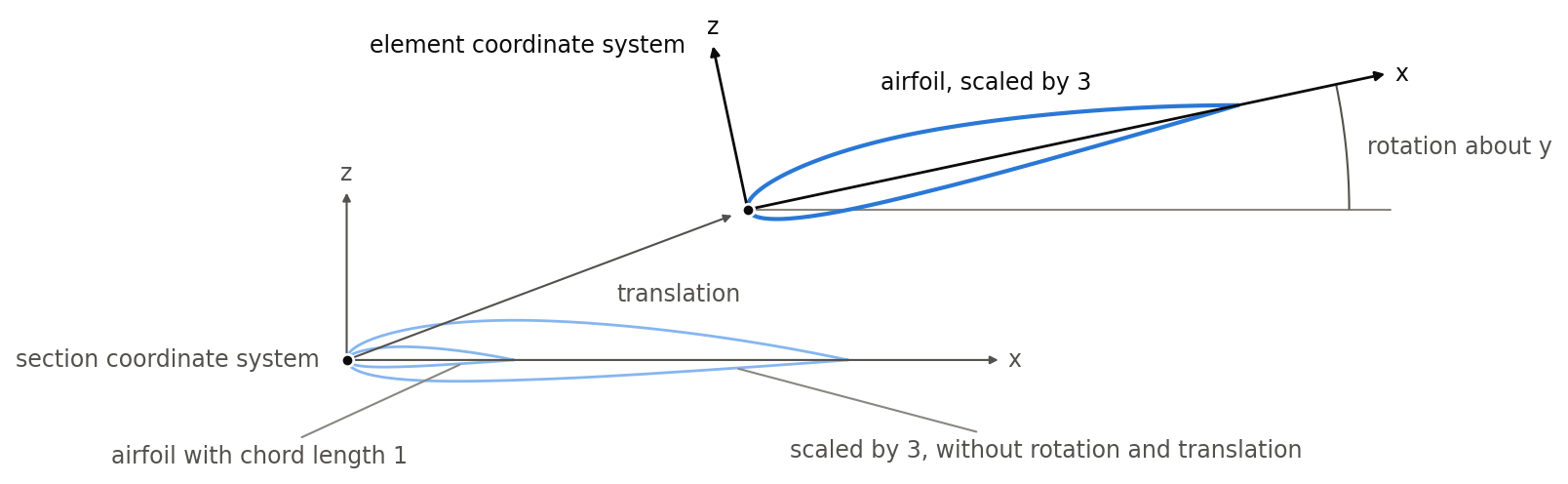
The figure shows an element whose coordinate system is translated and rotated about the y-axis within the section coordinate system; the airfoil, scaled by 3, lies in the element coordinate system. The pale contours show the airfoil with chord length 1 and scaled by 3, both without rotation and translation, i.e. with the element coordinate system on the section coordinate system. The values are illustrative. How the section in turn is placed in the wing is described in wingSectionType.
Segments start and end at elements, not at sections (wingSegmentType).
Several elements in a section
A section can hold several elements with different airfoils or transformations. They allow a step in the surface at the section: one segment ends at the first element, and the next segment starts at the second element. Segments can also branch at a section, e.g. to describe a split wingtip: two segments start at the same or at different elements of the section and lead to different outer sections.
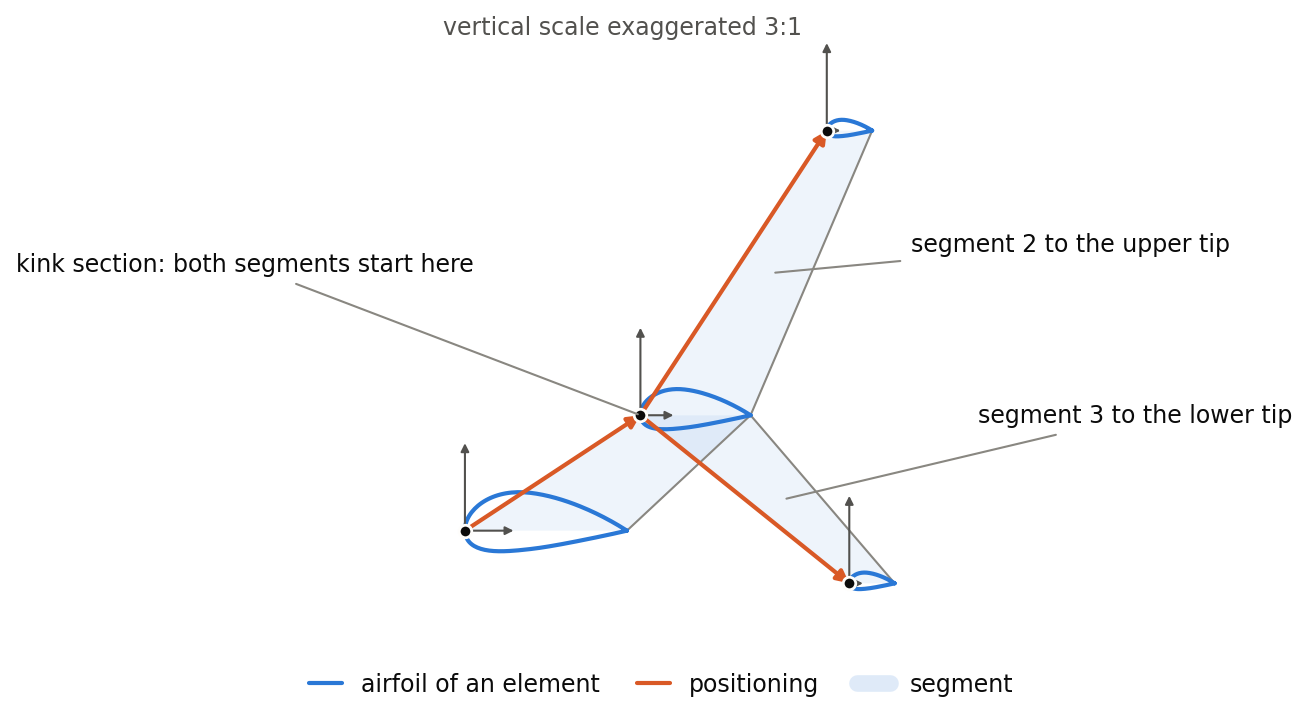
The figure shows a split wingtip: segment 1 leads from the root to the kink section, and segments 2 and 3 both start at the element of the kink section and lead to an upper and a lower tip section. The wing is an illustration; the vertical scale is exaggerated.
Example
The element of the kink section of the wing shown in wingType, scaling the airfoil to a chord length of 3.4:
<elements>
    <element uID="Wing_kink_element">
        <name>Kink element</name>
        <airfoilUID>NACA2412</airfoilUID>
        <transformation>
            <rotation>
                <x>0</x>
                <y>0</y>
                <z>0</z>
            </rotation>
            <scaling>
                <x>3.4</x>
                <y>1</y>
                <z>3.4</z>
            </scaling>
            <translation>
                <x>0</x>
                <y>0</y>
                <z>0</z>
            </translation>
        </transformation>
    </element>
</elements>