A vessel is the closed shell that holds the fuel. Its shape is given in one of two ways: either by sections and segments, as a fuselage is built, or by a few design parameters that describe a cylinder closed by two domes. The choice in the type keeps the two apart; a vessel uses one of them, never both.
Sections and segments
This branch uses the same types as a fuselage, including guide curves, and its cross sections are taken from the fuselageProfilesType collection. What a section and a segment mean, and how the profiles are placed and lofted, is defined in fuselageType and holds here without change. Use this branch wherever the vessel is not a body of revolution, for example where it follows the cross section of the fuselage around it.
Design parameters
The other branch describes a body of revolution by cylinderRadius, cylinderLength and a dome shape. Its meridian contour lies in the local x-z plane and is revolved about the local x-axis: it starts at the apex of the forward dome, reaches the cylinder radius R after the dome height h, runs along the cylinder for the length L and is mirrored at the middle of the cylinder. The origin of the vessel coordinate system is therefore the apex of the forward dome, not the centre of the vessel, and the vessel is L + 2h long. The dome height h follows from the dome shape and is defined with it in domeTypeType.
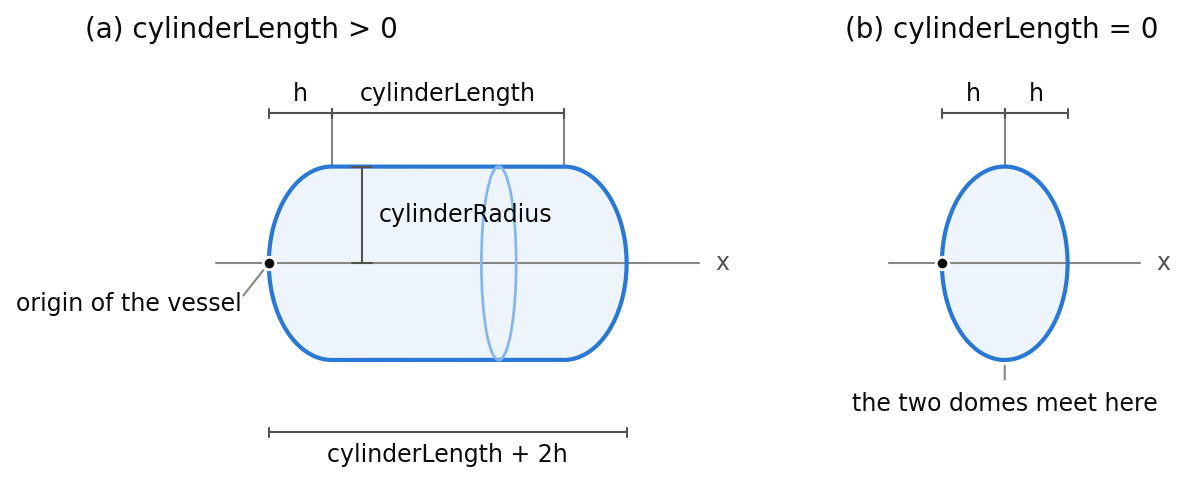
Figure (a) names the three lengths and marks the origin; the pale ellipse is the cross section that the contour sweeps out. Figure (b) shows that a cylinderLength of zero is a vessel in its own right, in which the two domes meet directly.
Structure
The structural layout is described in vesselStructureType, which uses the frames, stringers and walls of the fuselage structure and adds skin layers, because the wall of a vessel is usually built from more than one layer.
Volume and burst pressure
volume states how much fuel the vessel holds and how much of it can be used, in the form defined by fuelTankVolumeType. burstPressure is the internal pressure at which the vessel fails, not the pressure it is operated at.
Rules
-
cylinderRadiusandcylinderLengthdescribe the reference surface of the vessel, the surface the contour sweeps out. Layers given underskinLayerslie on it, towards the outside. -
cylinderRadiusis larger than zero,cylinderLengthis zero or larger. The largest radius of the vessel is the cylinder radius, whatever the dome shape. -
Both domes of a vessel have the same shape, so a vessel is symmetric about the middle of its cylinder.
The two excerpts show one vessel of each branch, taken from the tanks of the example.
<vessel uID="rearTank_outerVessel">
    <name>Outer vessel</name>
    <transformation>
        <translation>
            <x>0</x>
            <y>0</y>
            <z>0</z>
        </translation>
    </transformation>
    <cylinderRadius>1.45</cylinderRadius>
    <cylinderLength>4</cylinderLength>
    <domeType>
        <ellipsoid>
            <halfAxisFraction>0.65</halfAxisFraction>
        </ellipsoid>
    </domeType>
</vessel><vessel uID="forwardTank_vessel">
<name>Vessel</name>
<transformation>
<translation>
<x>0</x>
<y>0</y>
<z>0</z>
</translation>
</transformation>
<sections>
<section uID="forwardTank_front">
...
</section>
...
</sections>
<segments>
<segment uID="forwardTank_segment1">
<fromElementUID>forwardTank_front_element</fromElementUID>
<toElementUID>forwardTank_middle_element</toElementUID>
</segment>
...
</segments>
</vessel>