Describes how a pressure bulkhead is built: the sheet that closes the cross section of the fuselage, its shape — flat or curved — and its reinforcements. A bulkhead of a fuselage (pressureBulkheadAssemblyPositionType) places it at a frame; the surface it closes is described there.
Flat bulkhead
A flat bulkhead is the plane surface enclosed by the frame, typically at the front end of the pressurised fuselage. It is stiffened by <reinforcementNumberVertical> vertical and <reinforcementNumberHorizontal> horizontal profiles of the elements <structuralElementVerticalUID> and <structuralElementHorizontalUID>. The reinforcements are evenly distributed: n vertical reinforcements divide the width of the surface into n + 1 equal parts, and the horizontal ones divide its height in the same way.
Curved bulkhead
A curved bulkhead is a spherical calotte, typically at the rear end of the pressurised fuselage. In the plane of the frame, the edge of the calotte is a circle with the radius r = <bulkheadCalotteRadiusAtFrame> around the centroid of the surface enclosed by the frame. The calotte is curved backwards, towards +x, and its apex lies <maxFlectionDepth> = t behind that plane, so that its sphere has the radius R = (r² + t²) / (2t). Between the frame and the edge of the calotte, a flat ring closes the bulkhead. <reinforcementNumberRadial> radial reinforcements of the element <structuralElementRadialUID> run from the edge to the apex at equal angles.
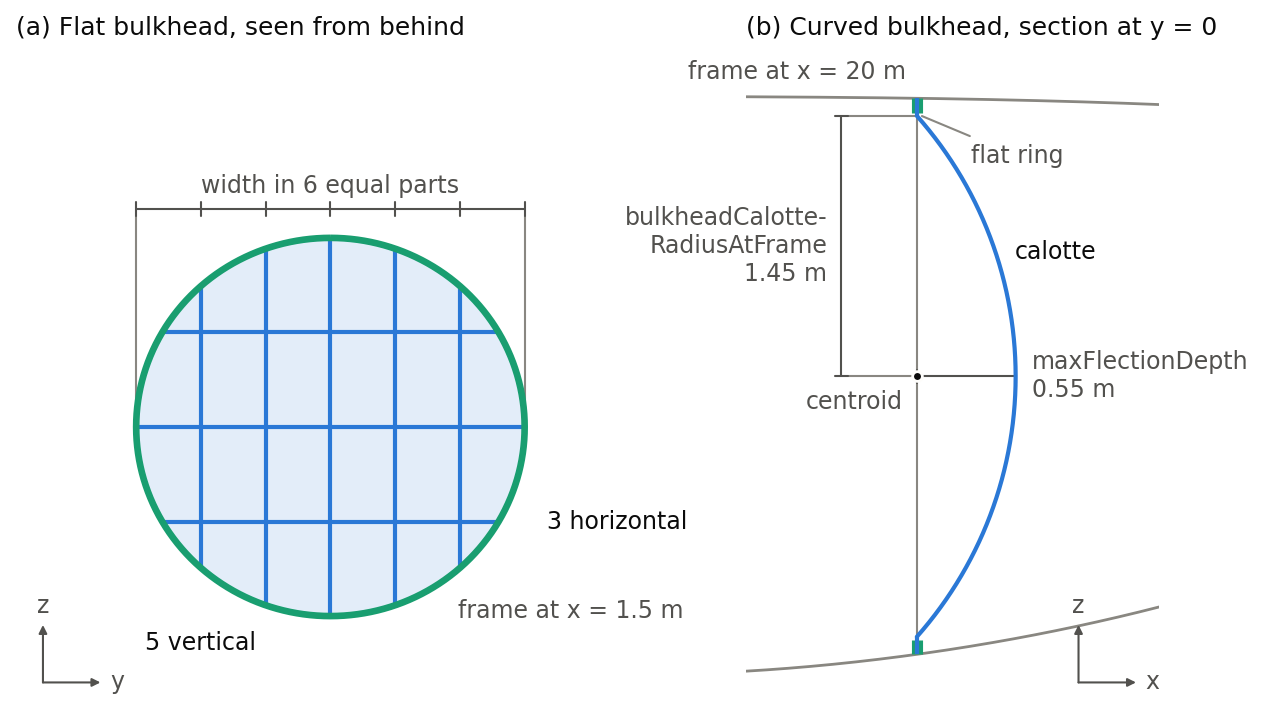
The figure shows the two bulkheads of the example. (a) The flat bulkhead at the frame at x = 1.5 m has five vertical and three horizontal reinforcements, which divide its width into six and its height into four equal parts. (b) The curved bulkhead at the frame at x = 20 m, in the section through its centroid, has a calotte of 1.45 m radius and 0.55 m depth; the flat ring between the frame and the calotte is about 0.1 m wide.
On which side of the sheet the reinforcements stand, and at which angle the first radial reinforcement lies, is not specified yet.
Rules
-
The radius of the calotte is smaller than the smallest distance from the centroid to the frame, so that the flat ring remains.
-
A number of reinforcements greater than 0 comes with the element of their profile.
Example
The elements of the two bulkheads of the example:
<pressureBulkheads>
    <pressureBulkhead uID="FwdPressureBulkhead">
        <name>Forward pressure bulkhead</name>
        <sheetElementUID>BulkheadFlat</sheetElementUID>
        <reinforcementNumberVertical>5</reinforcementNumberVertical>
        <structuralElementVerticalUID>ZFrame</structuralElementVerticalUID>
        <reinforcementNumberHorizontal>3</reinforcementNumberHorizontal>
        <structuralElementHorizontalUID>TStringer</structuralElementHorizontalUID>
    </pressureBulkhead>
    <pressureBulkhead uID="AftPressureBulkhead">
        <name>Aft pressure bulkhead</name>
        <sheetElementUID>BulkheadCalotte</sheetElementUID>
        <bulkheadCalotteRadiusAtFrame>1.45</bulkheadCalotteRadiusAtFrame>
        <maxFlectionDepth>0.55</maxFlectionDepth>
        <reinforcementNumberRadial>16</reinforcementNumberRadial>
        <structuralElementRadialUID>TStringer</structuralElementRadialUID>
    </pressureBulkhead>
</pressureBulkheads>