A positioning translates a section of a component, e.g. a wing or a fuselage, in the coordinate system of the component. Instead of Cartesian coordinates, the translation is given by a length and two angles, so that span, sweep and dihedral of a wing can be set directly. The positioning does not rotate the section.
Positioning vector
The positioning vector v is the y-axis scaled to the length L, rotated by the sweepAngle φ about the z-axis towards positive x, and then by the dihedralAngle ν about the x-axis towards positive z:

A positive sweep angle thus points the vector backwards, a positive dihedral angle upwards. With both angles equal to 0, the vector points along the y-axis. For a fuselage, whose sections follow the x-axis, a sweep angle of 90 points the vector along the x-axis.
The dihedral angle is the angle of the vector in the front view (y-z plane). The sweep angle is the angle between the vector and the y-z plane; in the top view, the vector appears more strongly swept if the dihedral angle is not 0.
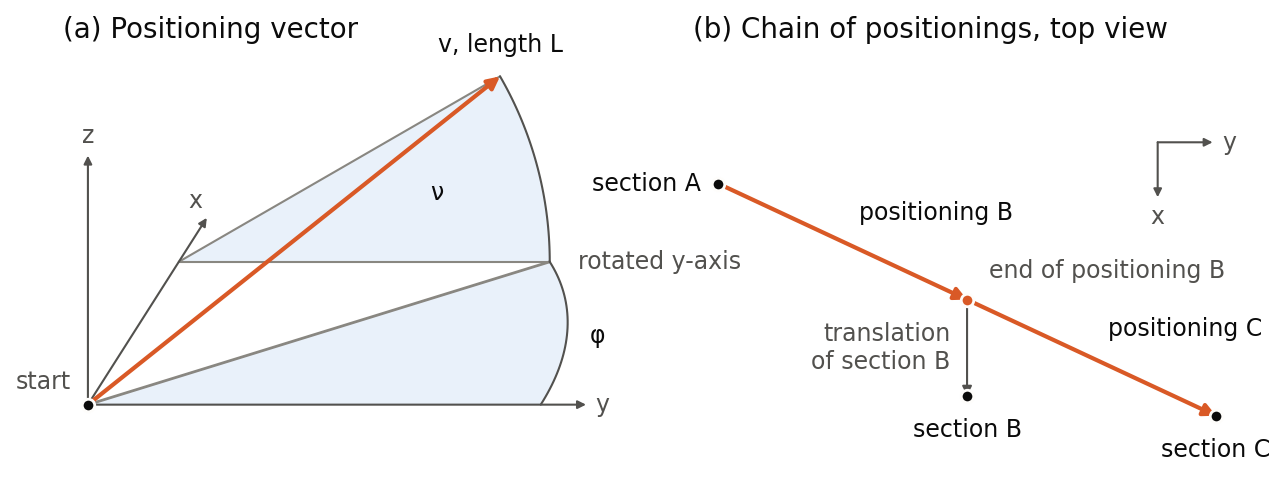
Figure (a) constructs the vector: the y-axis is first rotated by φ in the x-y plane and then by ν about the x-axis.
Chain of positionings
Without fromSectionUID, the vector starts at the origin of the component coordinate system. With fromSectionUID, it starts at the end of the positioning of the referenced section, so that positionings form a chain, e.g. from the root over the kink to the tip. The translation of the referenced section does not move this start point; the chain connects the ends of the positionings only. The origin of a section lies at the end of its positioning plus its own translation.
Figure (b) shows a chain in the top view. Section B is additionally translated by its transformation, and positioning C still starts at the end of positioning B.
-
Each section is positioned by at most one positioning, i.e. no two positionings reference the same section in
toSectionUID. -
A section referenced by
fromSectionUIDis positioned itself, i.e. it is thetoSectionUIDof another positioning. -
The positionings of a component do not form a cycle.
Example
The positionings of the wing shown in wingType: the root section stays at the origin, and the kink and tip sections are each positioned from the previous section.
<positionings>
    <positioning uID="Wing_root_positioning">
        <name>Root positioning</name>
        <length>0</length>
        <sweepAngle>0</sweepAngle>
        <dihedralAngle>0</dihedralAngle>
        <toSectionUID>Wing_root</toSectionUID>
    </positioning>
    <positioning uID="Wing_kink_positioning">
        <name>Kink positioning</name>
        <length>6</length>
        <sweepAngle>20</sweepAngle>
        <dihedralAngle>6</dihedralAngle>
        <fromSectionUID>Wing_root</fromSectionUID>
        <toSectionUID>Wing_kink</toSectionUID>
    </positioning>
    <positioning uID="Wing_tip_positioning">
        <name>Tip positioning</name>
        <length>9</length>
        <sweepAngle>28</sweepAngle>
        <dihedralAngle>6</dihedralAngle>
        <fromSectionUID>Wing_kink</fromSectionUID>
        <toSectionUID>Wing_tip</toSectionUID>
    </positioning>
</positionings>