A deck is a floor level of the fuselage, e.g. the passenger cabin of an airliner, with everything that belongs to it: the space available for the cabin, the aisles and spaces that are kept clear, the doors and the components installed on it, such as seats, galleys and lavatories. The components are elements of the library of deck elements (deckElementsType); the deck only gives where each of them stands.
Deck coordinate system
The deck is placed by its <transformation> relative to its parent, which is the fuselage that contains the deck unless <parentUID> names another component. Like every component with a parent, it follows only the translation of its parent (see transformationType). The origin of a passenger deck usually lies at the rear wall of the cockpit and at the height of the floor.
Everything the deck holds is given relative to the origin of the deck, with the floor at z = 0: the cabin geometry, the aisles, the spaces, the legacy door openings and the components. It follows only the translation of the deck, as a component follows its parent: a rotation or scaling of the deck does not apply to it, so a deck is usually only translated.
Layout
Each component references an element of the library by <deckElementUID> and places it with its own <transformation> (deckComponentBaseType). The cabin geometry describes the space available for the cabin (cabinGeometryType), aisles and spaces the areas of the floor that are kept clear (cabinAisleType, cabinSpaceType), and each door refers to its cut-out in the fuselage (deckDoorType).
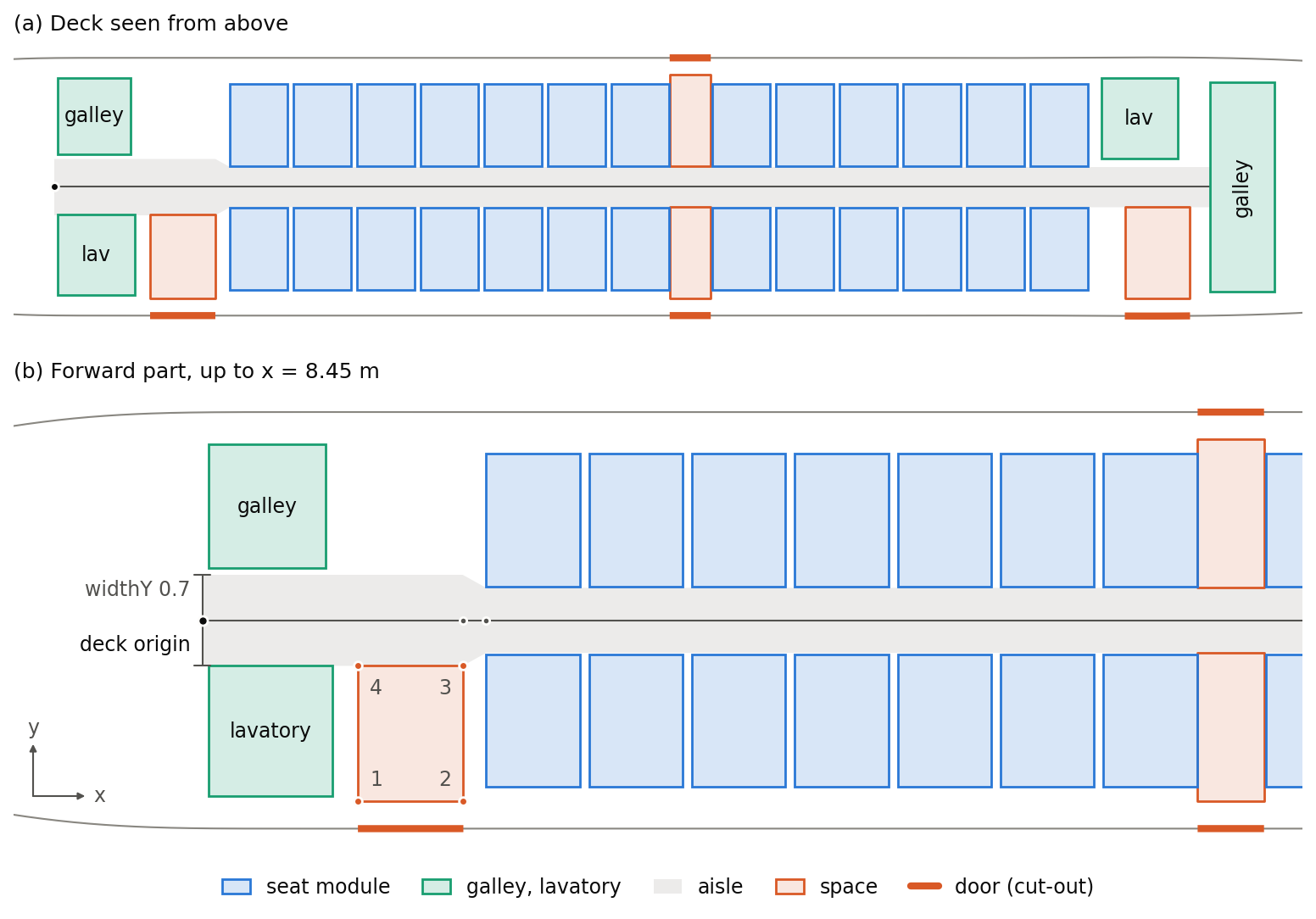
The figure shows the deck of the example below from above (a) and its forward part in detail (b). The origin lies at the rear wall of the cockpit; 13 rows of double seats stand on both sides of the aisle, galleys and lavatories at the ends of the cabin, and a space leads from the aisle to each door.
Rules
-
The components, aisles and spaces lie inside the fuselage and, where a cabin geometry is given, inside it.
-
The components overlap neither each other nor the spaces; components on the floor keep the aisles free.
Example
The main deck of a short-range airliner, with its origin at the rear wall of the cockpit, 4.6 m behind the nose, and at the height of the floor, 0.55 m below the axis of the fuselage:
<decks>
    <deck uID="mainDeck">
        <name>Main deck</name>
        <transformation>
            <translation>
                <x>4.6</x>
                <y>0</y>
                <z>-0.55</z>
            </translation>
        </transformation>
        <deckType>passenger</deckType>
        <cabinGeometry>
            ...
        </cabinGeometry>
        <seatModules>
            ...
        </seatModules>
        ...
    </deck>
</decks>