A track is the structural connection between a control surface and the wing: a flap track, the revolute joint of an aileron or a spoiler, or the kinematics of a slat. etaPosition gives its spanwise position; as for the borders of the control surface, the referenceUID of that coordinate says what it refers to.
The deflection path leads: where the control surface stands at a control parameter follows from its path (controlSurfacePathType). The track describes the mechanism that moves it there, over the same control parameter, and both have to agree.
trackType and trackSubType name the kinematics, trackStructure the parts of the track and the places of its joints (trackStructureType), and actuator the drive, if it belongs to the track (trackActuatorType).
Track types
The joints of a track are named P1 to P8 and its struts strut1 to strut3, by track type:
-
trackType1: a revolute joint. Its jointP1lies on the hinge line of the control surface (seecontrolSurfacePathType). No actuator belongs to the track. This is the only track type defined for spoilers. -
trackType2: a dropped hinge.P1sits at the wing and carriesstrut1, the drive strut, down to the hingeP2below the wing;strut2reaches from there toP4on the control surface, which is also held atP3. A linear or a rotary actuator belongs to the track. -
trackType3: a forward link and a carriage on a straight track.P1carries the rotary drive at the rear spar of the wing,strut2reaches down toP2on the fixed structure below the wing, and the forward linkstrut1fromP2toP3holds the front of the control surface. The carriage runs on the straight track fromP5toP6and carries the control surface atP4. -
trackType4: liketrackType3, with an upright link as aft support.strut3runs fromP5on the control surface down toP6on the fixed structure, and the ends of the straight track areP7andP8.
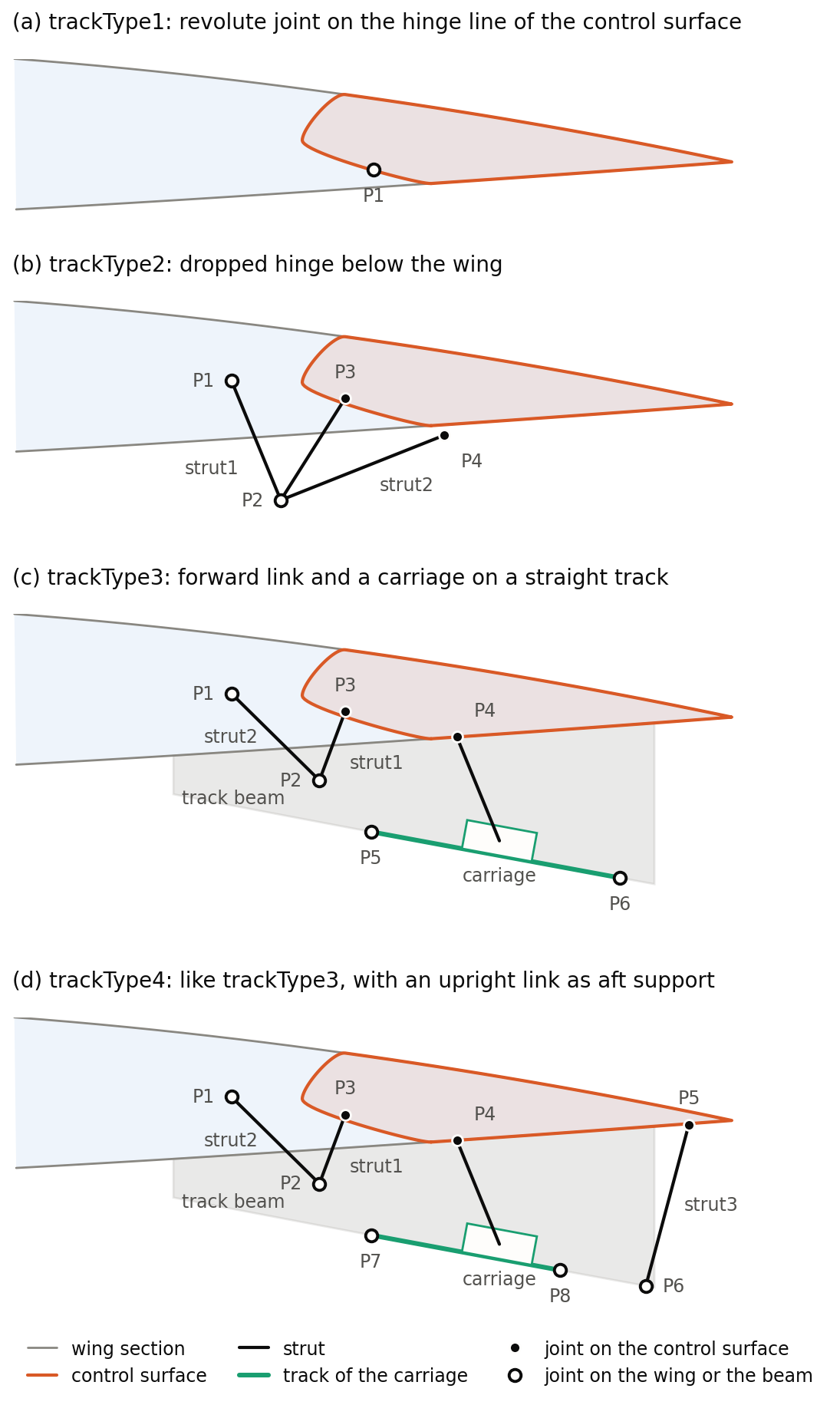
The figure shows the four track types in the section of the example wing at the inner border of its flap. The shapes of the wing and of the flap are the ones of the example in controlSurfacesType; the members of the mechanism are schematic, because the schema describes no shape for them.
Sub types
The sub type says how the track is attached to the wing and where its drive sits. Neither is expressed by the joints, so it only names the arrangement:
-
trackSubType1: the track is mounted on a box beam at the wing, and the rotary drive sits at the rear spar of the wing. FortrackType2the wing attachment is the box beam as well. -
trackSubType2: fortrackType2the wing attachment is the rear spar itself; fortrackType3andtrackType4the rotary drive is mounted on the track. -
trackSubType3: the track is mounted inside the fuselage at the wing root.
The list of types is not final; it is extended as further mechanisms are described.
Example
A track of the flap of the example in controlSurfacesType, with the places of its joints at the retracted and at the fully deflected position; only the first two joints are shown:
<track uID="Wing_flap_track1">
    <etaPosition>
        <eta>0.2</eta>
        <referenceUID>Wing_componentSegment</referenceUID>
    </etaPosition>
    <trackType>trackType3</trackType>
    <trackSubType>trackSubType1</trackSubType>
    <actuator uID="Wing_flap_track1_actuator">
        <actuatorUID>FlapRotaryActuator</actuatorUID>
        <material>
            <materialUID>Aluminium2024</materialUID>
        </material>
    </actuator>
    <trackStructure>
        <struts>
            <strut>
                <name>strut1</name>
                <materialUID>Aluminium2024</materialUID>
                <profileUID>TStringerProfile</profileUID>
            </strut>
            ...
        </struts>
        <jointPositions>
            <jointPosition>
                <controlParameters>0</controlParameters>
                <jointCoordinates>
                    <name>P1</name>
                    <x>3.7636</x>
                    <z>0.3910</z>
                </jointCoordinates>
            </jointPosition>
            <jointPosition>
                <controlParameters>0</controlParameters>
                <jointCoordinates>
                    <name>P2</name>
                    <x>4.3049</x>
                    <z>-0.0073</z>
                </jointCoordinates>
            </jointPosition>
            ...
        </jointPositions>
        <controlSurfaceAttachment>
            <materialUID>Aluminium2024</materialUID>
        </controlSurfaceAttachment>
        <carriage>
            <materialUID>Aluminium2024</materialUID>
        </carriage>
        ...
    </trackStructure>
</track>