The control surface is deflected about its hinge line, the straight line from the inner hinge point (innerHingePoint) at the inner border to the outer hinge point (outerHingePoint) at the outer border (controlSurfaceHingePointType). The steps give the deflection for increasing values of the control parameter.
In a step, the hinge points are translated along the axes of the wing coordinate system by innerHingeTranslation and outerHingeTranslation, and the control surface is rotated about the translated hinge line by hingeLineRotation. The rotation is right-handed about the direction from the inner to the outer hinge point, so that a positive rotation moves the trailing edge of a trailing edge device down. A point p of the control surface in its undeflected position moves to

where Pinner and Pouter are the hinge points, e the direction from Pinner to Pouter and L their distance. The translated hinge points have the direction e′ and the midpoint m′; Re→e′ is the smallest rotation that turns e into e′, and Re′(α) the rotation by the hinge line rotation α about e′. The control surface thus keeps its shape, and the midpoint of its hinge line is placed on the midpoint of the translated hinge points. If both hinge points are translated by the same vector t, the formula reduces to p′ = Pinner + t + Re(α) (p − Pinner).
Between two steps, the translations and the rotation are interpolated linearly over the control parameter. The steps are sorted by increasing control parameter, and the first and the last step limit the deflection (see the control parameters in cpacsType).
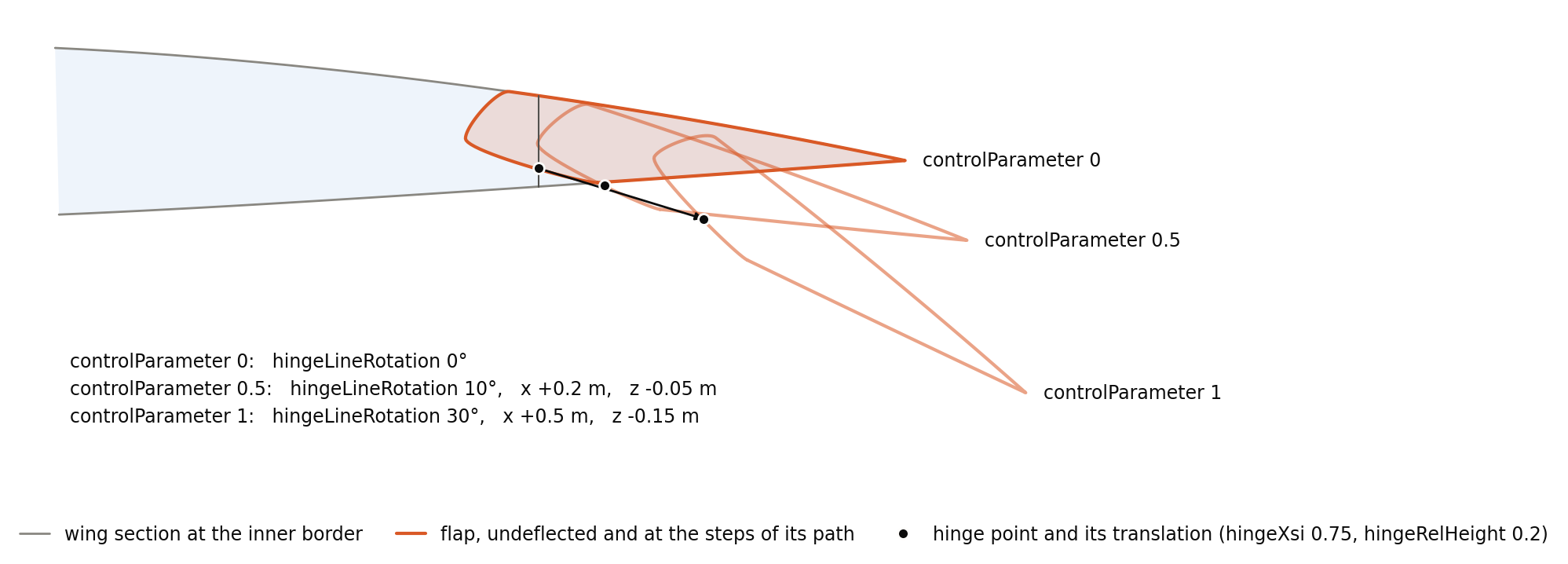
The figure shows the flap of the example in controlSurfacesType in the section of its inner border: the hinge point, and the flap at the three steps of its path, where it is translated backwards and down and rotated by up to 30°.
Example
<path>
    <innerHingePoint>
        <hingeXsi>0.75</hingeXsi>
        <hingeRelHeight>0.2</hingeRelHeight>
    </innerHingePoint>
    <outerHingePoint>
        <hingeXsi>0.76</hingeXsi>
        <hingeRelHeight>0.2</hingeRelHeight>
    </outerHingePoint>
    <steps>
        <step>
            <controlParameter>0</controlParameter>
            <hingeLineRotation>0</hingeLineRotation>
        </step>
        <step>
            <controlParameter>0.5</controlParameter>
            <innerHingeTranslation>
                <x>0.2</x>
                <y>0</y>
                <z>-0.05</z>
            </innerHingeTranslation>
            <outerHingeTranslation>
                <x>0.2</x>
                <z>-0.05</z>
            </outerHingeTranslation>
            <hingeLineRotation>10</hingeLineRotation>
        </step>
        <step>
            <controlParameter>1</controlParameter>
            <innerHingeTranslation>
                <x>0.5</x>
                <y>0</y>
                <z>-0.15</z>
            </innerHingeTranslation>
            <outerHingeTranslation>
                <x>0.5</x>
                <z>-0.15</z>
            </outerHingeTranslation>
            <hingeLineRotation>30</hingeLineRotation>
        </step>
    </steps>
</path>