

| superEllipseProfileType Complex Type |
Superellipse
Namespace: Empty
Schema: Empty
 Base Type
 UsagesChildren
| Name | Occurrences | Description |
|---|---|---|
 All All | ||
 lowerHeightFraction lowerHeightFraction | Height of the lower semi-ellipse relative to the total height | |
| mLower | Exponent m for lower semi-ellipse | |
| mUpper | Exponent m for upper semi-ellipse | |
| nLower | Exponent n for lower semi-ellipse | |
| nUpper | Exponent n for upper semi-ellipse |
Attributes| Name | Type | Required | Description |
|---|---|---|---|
 externalDataDirectory externalDataDirectory |  string string | Directory of the external data file | |
| externalDataNodePath | string | Path of the node inside the external data file | |
| externalFileName | string | Name of the external data file |
RemarksA profile based on superellipses is composed of an upper and a lower semi-ellipse, which may differ from each other in their parameterization. The total width and height of the profile is always 1, since scaling is performed after referencing (e.g., in the fuselage).
This lowerHeightFraction describes the portion of the lower semi-ellipse on the total height.
The resulting profile is defined by the following set of equations:


with

The following examples indicate the various possibilities of parametric profiles:
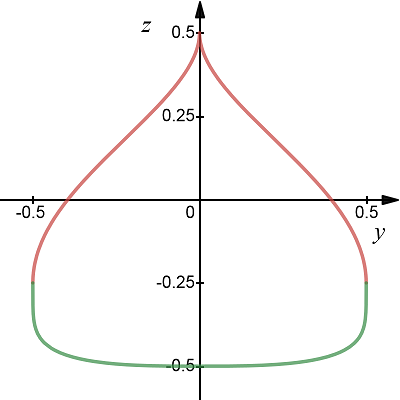
Example 1: (mUpper,nUpper,mLower,nLower, lowerHeightFraction) = (0.5; 2; 5; 3; 0.25)
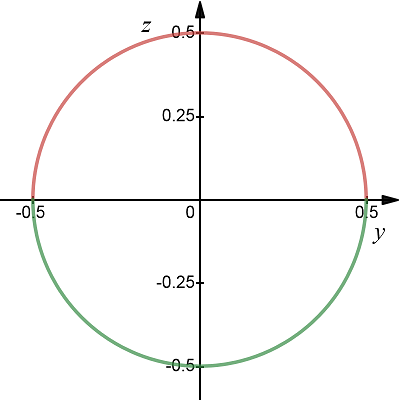
Example 2: (mUpper,nUpper,mLower,nLower, lowerHeightFraction) = (2; 2; 2; 2; 0.5) = a circle
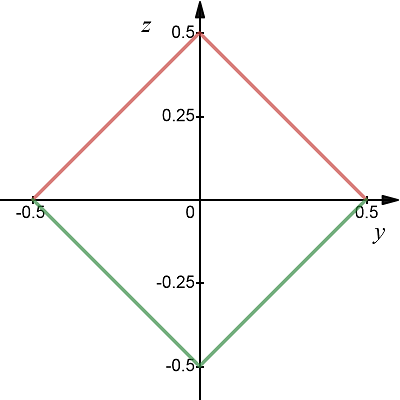
Example 3: (mUpper,nUpper,mLower,nLower, lowerHeightFraction) = (1; 1; 1; 1; 0.5) = a square / diamond
Note: For exponents that are infinitely large, the superellipse converges to a rectangle. However, the value Inf is not a valid entry at this point. Use the square element instead.