A fuel tank groups the vessels that are filled and emptied together. The tank has no shape of its own: its geometry is the set of its vessels, and what it adds is the place in the aircraft that they share.
Placement
A tank is placed like any other component of the model, and the rules of transformationType apply to it unchanged. With parentUID the tank names the component it is attached to, usually a fuselage or a wing, and then follows the translation of that component but neither its rotation nor its scaling. Without a parent the transformation is read in the global coordinate system.
The attribute symmetry mirrors the whole tank, with all its vessels, at the named plane, so that a tank which exists on both sides of the aircraft is written once.
Vessels
The vessels of a tank are nested in its coordinate system, so the transformation of the tank scales and rotates them together with their own translation. Several vessels form one tank wherever they are filled as one, for example a pressure vessel inside a vacuum jacket, or a row of cylinders below the cabin floor.
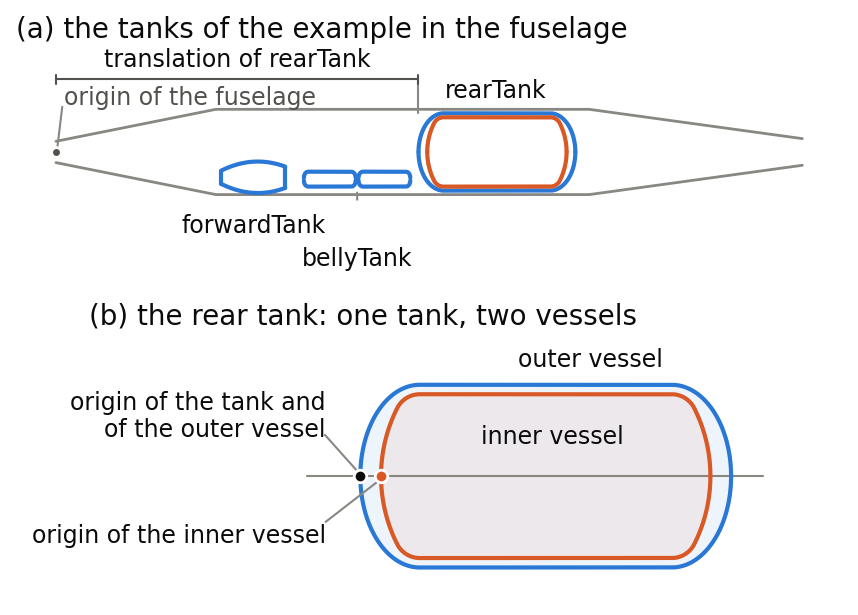
Figure (a) shows three tanks in the fuselage they are attached to, and the translation of the rear tank measured from the origin of that fuselage. Figure (b) enlarges the rear tank: the pressure vessel sits inside the vacuum jacket, and the two vessels have different origins because each of them starts at the apex of its own forward dome.
The excerpt shows the rear tank of the figure, with the two vessels shortened; vesselType gives them in full.
<fuelTank uID="rearTank">
    <name>Rear tank</name>
    <description>Liquid hydrogen tank behind the cabin: a pressure vessel with torispherical domes inside a vacuum jacket with ellipsoidal domes.</description>
    <parentUID>Fuselage</parentUID>
    <transformation>
        <translation>
            <x>13.6</x>
            <y>0</y>
            <z>0</z>
        </translation>
    </transformation>
    <vessels>
        <vessel uID="rearTank_outerVessel">
            <name>Outer vessel</name>
            ...
        </vessel>
        <vessel uID="rearTank_innerVessel">
            <name>Inner vessel</name>
            ...
        </vessel>
    </vessels>
</fuelTank>