A flight envelope is the range of altitude and speed in which the aircraft is operated. It is bounded by curves of characteristic speeds over altitude, such as the stall speed VS on the low-speed side and the maximum operating speed VMO on the high-speed side, each given as a <speed>. The altitudes refer to <atmosphericModel>, shifted by <deltaTemperature> (section 10 of cpacsType). The speeds are true airspeeds, so that the curves of a hot day differ from those of a standard day.
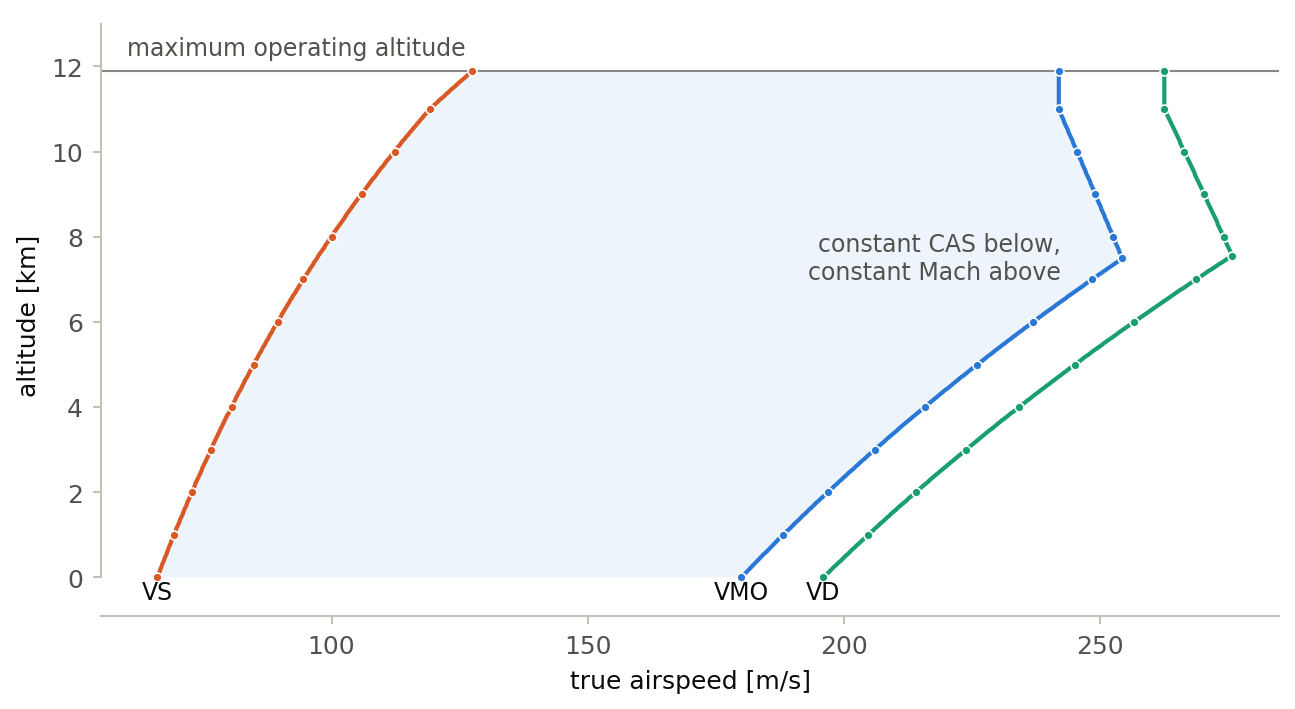
The figure shows the flight envelope of a short-range airliner with the points of the example below. Up to about 7.5 km, VMO and the design diving speed VD are constant calibrated airspeeds, whose true airspeed grows with altitude; above, they are limited by a constant Mach number, the maximum operating Mach number for VMO and the design diving Mach number for VD. The curves named VMO and VD include these parts limited by a Mach number. The shaded area between the stall speed and the maximum operating speed is the normal operating range; all curves end at the maximum operating altitude.
<flightEnvelope>
    <atmosphericModel>ISA</atmosphericModel>
    <speed>
        <speedName>VS</speedName>
        <altitude>0;1000;2000;3000;4000;5000;6000;7000;8000;9000;10000;11000;11887</altitude>
        <trueAirSpeed>66;69.2;72.7;76.5;80.5;84.8;89.5;94.5;100;105.9;112.3;119.2;127.5</trueAirSpeed>
    </speed>
    <speed>
        <speedName>VMO</speedName>
        <altitude>0;1000;2000;3000;4000;5000;6000;7000;7489;8000;9000;10000;11000;11887</altitude>
        <trueAirSpeed>180;188.2;196.9;206.1;215.8;226.1;237;248.5;254.4;252.6;249.1;245.6;242;242</trueAirSpeed>
    </speed>
    <speed>
        <speedName>VD</speedName>
        <altitude>0;1000;2000;3000;4000;5000;6000;7000;7555;8000;9000;10000;11000;11887</altitude>
        <trueAirSpeed>196;204.8;214.1;223.9;234.2;245.2;256.7;268.8;275.8;274.2;270.4;266.5;262.6;262.6</trueAirSpeed>
    </speed>
</flightEnvelope>