Ducts are bodies that are cut out of other components: the air intake of an engine, a tunnel through a fuel tank, a bay in a fuselage. A duct describes the shape of such a body, and a duct assembly combines ducts into one body and removes it from the fuselages, wings and fuel tanks of the model.
-
<duct>(ductType) is a body built like a fuselage, from sections, elements, positionings and segments. It has no material of its own: it describes the space it takes out of other components. -
<ductAssembly>(ductAssemblyType) references ducts by their UID, fuses them into one body and places this body in the model. A duct takes effect only through an assembly; a duct that no assembly references cuts nothing.
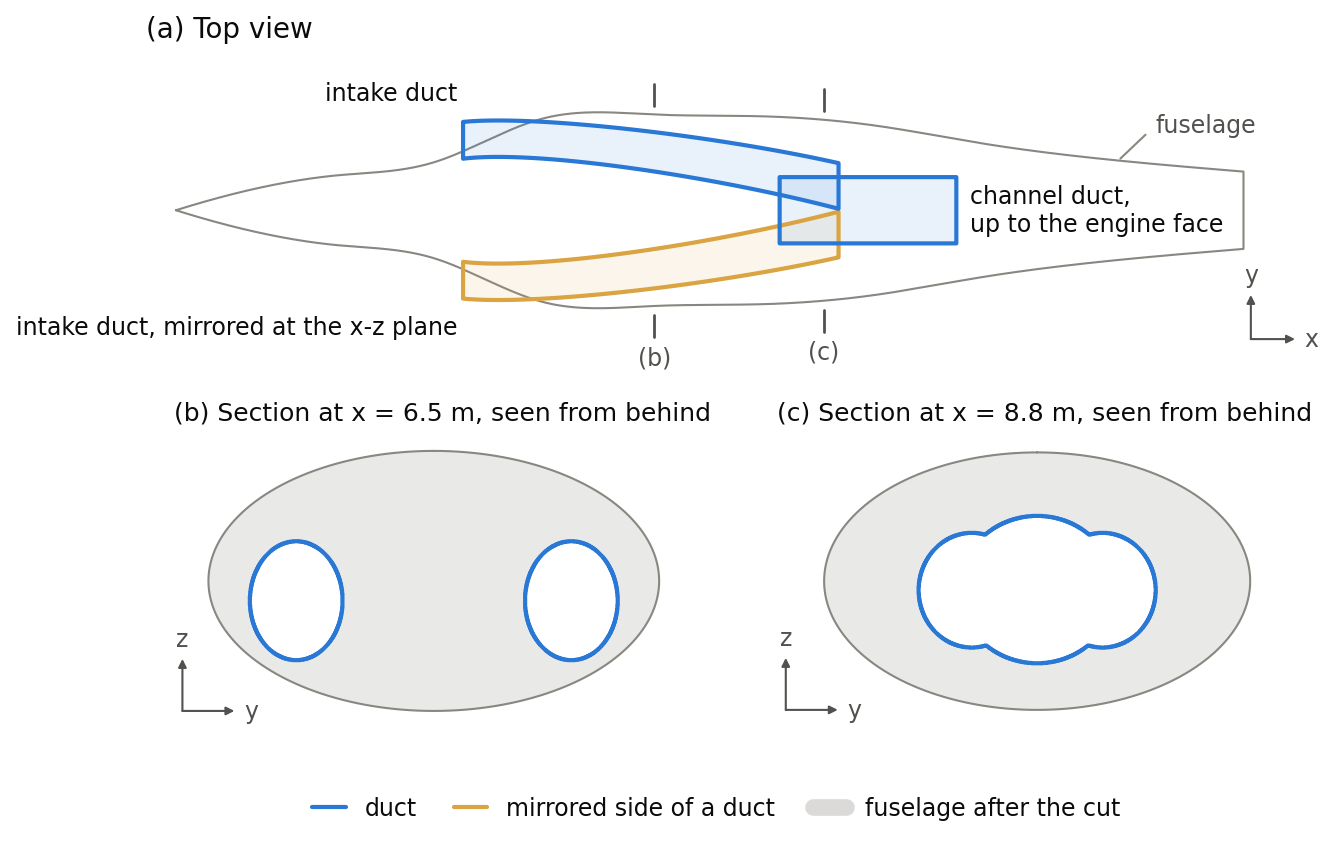
The figure shows the example below. In the top view (a), the intake duct on the side y > 0 starts in front of the fuselage, so that the cut opens the side of the fuselage where it widens; its mirror image is the intake on the other side. Both reach into the channel duct, so that the three bodies form one channel up to the engine face. The sections (b) and (c) show the fuselage after the cut: one hole behind each intake, and a single one where the ducts merge.
Example
The air intake of a single-engine fighter: the intake duct is written once and mirrored at the x-z plane, and the channel duct lies on the axis. The assembly fuses the three bodies and cuts them out of the fuselage, to which it is attached. The sections of the ducts are written like those of a fuselage (fuselageSectionType).
<ducts>
    <duct uID="IntakeDuct" symmetry="x-z-plane">
        <name>Intake duct</name>
        ...
    </duct>
    <duct uID="ChannelDuct">
        <name>Channel duct</name>
        ...
    </duct>
    <ductAssembly uID="IntakeDuctAssembly">
        <name>Intake ducts</name>
        <description>Air intake of the engine, cut out of the fuselage</description>
        <parentUID>Fuselage</parentUID>
        <transformation>
            <rotation>
                <x>0</x>
                <y>0</y>
                <z>0</z>
            </rotation>
            <scaling>
                <x>1</x>
                <y>1</y>
                <z>1</z>
            </scaling>
            <translation>
                <x>0</x>
                <y>0</y>
                <z>0</z>
            </translation>
        </transformation>
        <ductUIDs>
            <uID>IntakeDuct</uID>
            <uID>ChannelDuct</uID>
        </ductUIDs>
    </ductAssembly>
</ducts>